
Determine whether or not the mixing of each pair of solutions results in a buffer. a. 75.0 mL of 0.10 M HF; 55.0 mL of 0.15 M NaF b. 150.0 mL of 0.10 M HF; 135.0 mL of 0.175 M HCl d. 125.0 mL of 0.15 M CH3NH2; 120.0 mL of 0.25 M CH3NH3Cl
Ch.17 - Aqueous Ionic Equilibrium
Chapter 17, Problem 53d
Determine whether or not the mixing of each pair of solutions results in a buffer. d. 175.0 mL of 0.10 M NH3; 150.0 mL of 0.12 M NaOH
Verified step by step guidance1
Identify the components needed for a buffer solution: a weak acid and its conjugate base, or a weak base and its conjugate acid.
Recognize that NH3 (ammonia) is a weak base and NaOH (sodium hydroxide) is a strong base.
Understand that a buffer solution requires a weak base and its conjugate acid, not a strong base.
Calculate the moles of NH3: \( \text{moles of NH3} = 0.175 \text{ L} \times 0.10 \text{ M} \).
Calculate the moles of NaOH: \( \text{moles of NaOH} = 0.150 \text{ L} \times 0.12 \text{ M} \).

Verified video answer for a similar problem:
This video solution was recommended by our tutors as helpful for the problem above.
Video duration:
6mWas this helpful?
Key Concepts
Here are the essential concepts you must grasp in order to answer the question correctly.
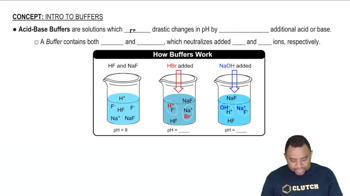
Buffer Solutions
A buffer solution is a system that resists changes in pH upon the addition of small amounts of acid or base. It typically consists of a weak acid and its conjugate base or a weak base and its conjugate acid. Buffers are crucial in maintaining stable pH levels in various chemical and biological processes.
Recommended video:
Guided course
Buffer Solutions
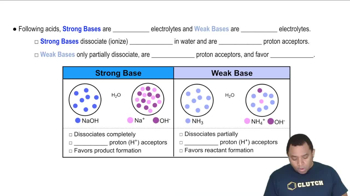
Weak Bases and Strong Bases
Weak bases, like ammonia (NH3), partially ionize in solution, establishing an equilibrium between the base and its conjugate acid (NH4+). In contrast, strong bases, such as sodium hydroxide (NaOH), fully dissociate in solution, leading to a significant increase in hydroxide ions (OH-). Understanding the behavior of these bases is essential for determining buffer capacity.
Recommended video:
Guided course
Strong vs Weak Bases
Concentration and Volume in Solution Chemistry
The concentration of a solution, expressed in molarity (M), indicates the amount of solute per liter of solution. When mixing solutions, the total volume and the concentrations of the individual components must be considered to determine the final concentrations of the resulting mixture. This is important for assessing whether the mixture can act as a buffer.
Recommended video:
Guided course
Constant-Volume Calorimetry
Related Practice
Textbook Question
1
views
Textbook Question
Determine whether or not the mixing of each pair of solutions results in a buffer. b. 50.0 mL of 0.10 M HCl; 35.0 mL of 0.150 M NaOH
1
views
Textbook Question
Determine whether or not the mixing of each pair of solutions results in a buffer. c. 165.0 mL of 0.10 M HF; 135.0 mL of 0.050 M KOH
1
views
Textbook Question
Determine whether or not the mixing of each pair of solutions results in a buffer. a. 100.0 mL of 0.10 M NH3; 100.0 mL of 0.15 M NH4Cl
1
views
Textbook Question
Determine whether or not the mixing of each pair of solutions results in a buffer. e. 125.0 mL of 0.15 M NH3; 150.0 mL of 0.20 M NaOH
1
views
Textbook Question
Determine whether or not the mixing of each pair of solutions results in a buffer. c. 50.0 mL of 0.15 M HF; 20.0 mL of 0.15 M NaOH
1
views
