The half-life for the radioactive decay of C-14 is 5730 years and is independent of the initial concentration. How long does it take for 25% of the C-14 atoms in a sample of C-14 to decay?
Ch.14 - Chemical Kinetics
Chapter 14, Problem 61
The activation energy of a reaction is 56.8 kJ/mol and the frequency factor is 1.5⨉1011/ s. Calculate the rate constant of the reaction at 25 °C.
Verified step by step guidance1
Convert the temperature from Celsius to Kelvin by adding 273.15 to the given temperature in Celsius: \( T = 25 + 273.15 \).
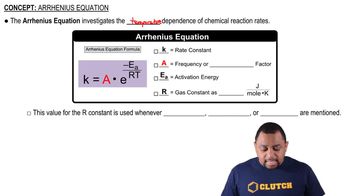
Use the Arrhenius equation to relate the rate constant \( k \) to the activation energy \( E_a \), frequency factor \( A \), and temperature \( T \): \( k = A \cdot e^{-E_a/(RT)} \).
Convert the activation energy from kJ/mol to J/mol by multiplying by 1000: \( E_a = 56.8 \times 1000 \).
Use the gas constant \( R = 8.314 \) J/(mol·K) in the Arrhenius equation.
Substitute the values for \( A \), \( E_a \), \( R \), and \( T \) into the Arrhenius equation and solve for \( k \).

Verified video answer for a similar problem:
This video solution was recommended by our tutors as helpful for the problem above.
Video duration:
1mWas this helpful?
Key Concepts
Here are the essential concepts you must grasp in order to answer the question correctly.
Activation Energy
Activation energy is the minimum energy required for a chemical reaction to occur. It represents the energy barrier that reactants must overcome to transform into products. In the context of the Arrhenius equation, a higher activation energy typically results in a slower reaction rate, as fewer molecules have sufficient energy to react at a given temperature.
Recommended video:
Guided course
Activity Series Chart
Arrhenius Equation
The Arrhenius equation relates the rate constant of a reaction to its activation energy and temperature. It is expressed as k = A * e^(-Ea/RT), where k is the rate constant, A is the frequency factor, Ea is the activation energy, R is the universal gas constant, and T is the temperature in Kelvin. This equation highlights how temperature and energy barriers influence reaction rates.
Recommended video:
Guided course
Arrhenius Equation
Rate Constant
The rate constant (k) is a proportionality factor in the rate law of a chemical reaction, indicating the speed at which the reaction occurs. It is influenced by factors such as temperature and activation energy. A higher rate constant signifies a faster reaction, while a lower rate constant indicates a slower reaction, making it a crucial parameter in chemical kinetics.
Recommended video:
Guided course
Rate Constant Units
Related Practice
Textbook Question
Textbook Question
The diagram shows the energy of a reaction as the reaction progresses. Label each blank box in the diagram.
a. reactants b. products c. activation energy (Ea) d. enthalpy of reaction (ΔHrxn)
Textbook Question
The half-life for the radioactive decay of C-14 is 5730 years and is independent of the initial concentration. If a sample of C-14 initially contains 1.5 mmol of C-14, how many millimoles are left after 2255 years?
Textbook Question
The rate constant (k) for a reaction was measured as a function of temperature. A plot of ln k versus 1/T (in K) is linear and has a slope of -7445 K. Calculate the activation energy for the reaction.
1
views