
Textbook Question
Consider this three-step mechanism for a reaction:
Cl2 (g) k1⇌k2 2 Cl (g) Fast
Cl (g) + CHCl3 (g) →k3 HCl (g) + CCl3 (g) Slow
Cl (g) + CCl3 (g) →k4 CCl4 (g) Fast
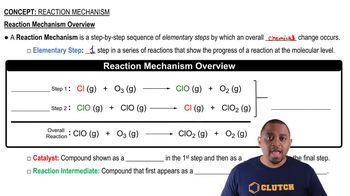
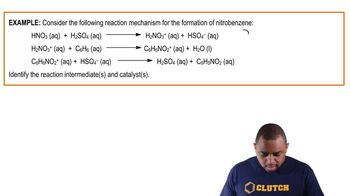
a. What is the overall reaction?
 Verified step by step guidance
 03:06
03:06
 02:14
02:14 01:15
01:15Consider this three-step mechanism for a reaction:
Cl2 (g) k1⇌k2 2 Cl (g) Fast
Cl (g) + CHCl3 (g) →k3 HCl (g) + CCl3 (g) Slow
Cl (g) + CCl3 (g) →k4 CCl4 (g) Fast
a. What is the overall reaction?
Consider this three-step mechanism for a reaction:
Cl2 (g) k1⇌k2 2 Cl (g) Fast
Cl (g) + CHCl3 (g) →k3 HCl (g) + CCl3 (g) Slow
Cl (g) + CCl3 (g) →k4 CCl4 (g) Fast
c. What is the predicted rate law?
Consider this two-step mechanism for a reaction: NO2(g) + Cl2(g) → k1 ClNO2(g) + Cl g) Slow NO2(g) + Cl(g) →k2 ClNO2(g) Fast b. Identify the intermediates in the mechanism.
Consider this overall reaction, which is experimentally observed to be second order in AB and zero order in C: AB + C → A + BC Is the following mechanism valid for this reaction? AB + AB →k1 AB2 + A Slow AB2 + C → k2 AB + BC Fast