
Textbook Question
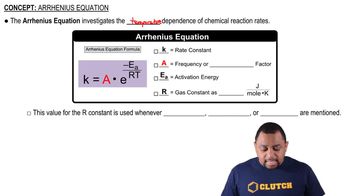
A reaction has a rate constant of 0.0117/s at 400.0 K and 0.689/s at 450.0 K. a. Determine the activation barrier for the reaction.
1
views
 Verified step by step guidance
 00:45
00:45
 01:20
01:20 02:10
02:10A reaction has a rate constant of 0.0117/s at 400.0 K and 0.689/s at 450.0 K. a. Determine the activation barrier for the reaction.
Consider these two gas-phase reactions: a. AA(g) + BB(g) → 2 AB(g) b. AB(g) + CD(g) → AC(g) + BD(g) If the reactions have identical activation barriers and are carried out under the same conditions, which one would you expect to have the faster rate?
The tabulated data show the rate constant of a reaction measured at several different temperatures. Use an Arrhenius plot to determine the activation barrier and frequency factor for the reaction.
Temperature (K) Rate Constant (1 , s)
310 0.00434
320 0.0140
330 0.0421
340 0.118
350 0.316