
Textbook Question
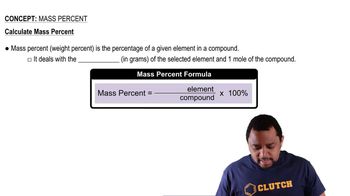
An aqueous NaCl solution is made using 112 g of NaCl diluted to a total solution volume of 1.00 L. Calculate the mass percent of the solution. (Assume a density of 1.08 g/mL for the solution.)
 Verified step by step guidance
 00:38
00:38
 01:09
01:09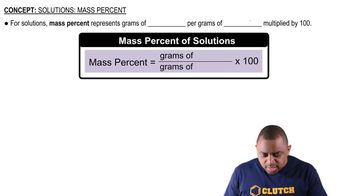 00:24
00:24An aqueous NaCl solution is made using 112 g of NaCl diluted to a total solution volume of 1.00 L. Calculate the mass percent of the solution. (Assume a density of 1.08 g/mL for the solution.)
An aqueous KNO3 solution is made using 72.5 g of KNO3 diluted to a total solution volume of 2.00 L. Calculate the molality of the solution. (Assume a density of 1.05 g/mL for the solution.)
An aqueous KNO3 solution is made using 72.5 g of KNO3 diluted to a total solution volume of 2.00 L. Calculate the molarity of the solution. (Assume a density of 1.05 g/mL for the solution.)
Silver nitrate solutions are often used to plate silver onto other metals. What is the maximum amount of silver (in grams) that can be plated out of 4.8 L of an AgNO3 solution containing 3.4% Ag by mass? Assume that the density of the solution is 1.01 g/mL.
To what volume should you dilute 50.0 mL of a 5.00 M KI solution so that 25.0 mL of the diluted solution contains 3.05 g of KI?