
Ch.9 - Thermochemistry: Chemical Energy
McMurry - Chemistry 8th Edition
McMurry8th EditionChemistryISBN: 9781292336145Not the one you use?Change textbook
Chapter 9, Problem 95

Hess's law can be used to calculate reaction enthalpies for hypothetical processes that can't be carried out in the labo- ratory. Set up a Hess's law cycle that will let you calculate ∆H° for the conversion of methane to ethylene: 2 CH4(g) → C2H4(g) + 2 H2(g) You can use the following information: 2 C2H6(g) + 7 O2(g) → 4 CO2(g) + 6 H2O(l) ∆H° = -3120.8 kJ CH4(g) + 2 O2(g) → CO2(g) + 2 H2O(l) ∆H° = -890.3 kJ C2H4(g) + H2(g) → C2H6(g) ∆H° = -136.3 kJ H2O(l) ∆H°f = -285.8 kJ/mol

Verified step by step guidance
1
Identify the target reaction: 2 CH4(g) → C2H4(g) + 2 H2(g).
Write the given reactions and their enthalpies: (1) 2 C2H6(g) + 7 O2(g) → 4 CO2(g) + 6 H2O(l), ΔH° = -3120.8 kJ; (2) CH4(g) + 2 O2(g) → CO2(g) + 2 H2O(l), ΔH° = -890.3 kJ; (3) C2H4(g) + H2(g) → C2H6(g), ΔH° = -136.3 kJ.
Reverse reaction (3) to get C2H6(g) → C2H4(g) + H2(g), changing the sign of ΔH° to +136.3 kJ.
Use reaction (2) twice to represent the combustion of 2 CH4(g), resulting in 2 CO2(g) + 4 H2O(l) and a total ΔH° of 2(-890.3 kJ).
Combine the modified reactions to form a Hess's law cycle: 2 CH4(g) → 2 CO2(g) + 4 H2O(l) (from reaction 2), 2 C2H6(g) → 4 CO2(g) + 6 H2O(l) (from reaction 1), and C2H6(g) → C2H4(g) + H2(g) (reversed reaction 3). Calculate ΔH° for the target reaction by adding the enthalpies of these steps.

Verified video answer for a similar problem:

This video solution was recommended by our tutors as helpful for the problem above.
Video duration:
2m

Key Concepts

Here are the essential concepts you must grasp in order to answer the question correctly.

Hess's Law

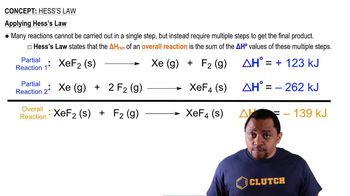
Hess's Law states that the total enthalpy change for a chemical reaction is the same, regardless of the number of steps taken to complete the reaction. This principle allows chemists to calculate the enthalpy change of a reaction by using the enthalpy changes of related reactions, making it particularly useful for reactions that are difficult to measure directly.
Recommended video:

Enthalpy of Formation (∆H°f)

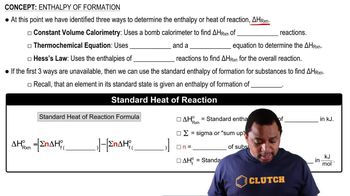
The enthalpy of formation (∆H°f) is the change in enthalpy when one mole of a compound is formed from its elements in their standard states. This value is crucial for calculating reaction enthalpies using Hess's Law, as it provides a reference point for the energy changes associated with the formation of compounds from their constituent elements.
Recommended video:
Guided course
02:34
Enthalpy of Formation

Standard Enthalpy Change (∆H°)

The standard enthalpy change (∆H°) refers to the heat change that occurs at constant pressure when reactants are converted to products under standard conditions (1 atm pressure and a specified temperature, usually 25°C). This value is essential for understanding the energy dynamics of chemical reactions and is used in Hess's Law calculations to derive the enthalpy changes for complex reactions.
Recommended video:
Guided course
02:34
Enthalpy of Formation
Related Practice
Textbook Question
The following steps occur in the reaction of ethyl alcohol (CH3CH2OH) wiht oxygen to yield acetic acid (CH3CO2H). Show that equations 1 and 2 sum to give the net equation and calculate ΔH° for the net equation. (1) CH3CH2OH(l) + 1/2 O2(g) → CH3CHO (g) + H2O(l) ΔH° = -174.2 kJ (2) CH3CHO(g) + 1/2 O2(g) → CH3CO2H(l) ΔH° = -318.4 kJ (Net) CH3CH2OH(l) + O2(g) → CH3CO2H(l) + H2O(l) ΔH° = ?
Textbook Question
The industrial degreasing solvent methylene chloride, CH2Cl2, is prepared from methane by reaction with chlorine: CH4(g) + 2 Cl2(g) → CH2Cl2(g) + 2 HCl(g) Use the following data to calcualte ΔH° in kilojoules for the reaction: CH4(g) + Cl2(g) → CH3Cl(g) + HCl(g) ΔH° = -98.3 kJ CH3Cl(g) + Cl2(g) → CH2Cl2(g) + HCl(g) ΔH° = -104 kJ
Textbook Question
Set up a Hess's law cycle, and use the following information to calculate ΔH°f for aqueous nitiric acid, HNO3(aq). You will need to use fractional coefficients for some equations. 3 NO2(g) + H2O(l) → 2 HNO3(aq) + NO(g) ΔH° = -137.3 kJ 2 NO(g) + O2(g) → 2 NO2(g) ΔH° = -116.2 kJ 4 NH3(g) + 5 O2(g) → 4 NO (g) + 6 H2O(l) ΔH° = -1165.2 kJ NH3(g) ΔH°f = -46.1 kJ/mol H2O(l) ΔH°f = -285.8 kJ/mol
1
views
Textbook Question
What is a compound's standard heat of formation?
Textbook Question
Find ∆H° in kilojoules for the reaciton of nitric oxide with oxygen, 2 NO(g) + O2(g) → N2O4(g), given the following data: N2O4(g) → 2 NO2(g) ∆H° = 55.3 kJ NO(g) + 1/2 O2(g) → NO2(g) ∆H° = -58.1 kJ
Textbook Question
What is Hess's law, and why does it 'work'?
1
views