Which atom or ion in the following pairs would you expect to be larger?
(c) Cr3+ or Cr6+
Verified step by step guidance
1
Identify the concept of ionic size: Ionic size is influenced by the number of electrons and the effective nuclear charge.
Understand the charge of each ion: Cr^{3+} has lost 3 electrons, while Cr^{6+} has lost 6 electrons.
Consider the electron configuration: Cr^{3+} has fewer electrons than the neutral atom, and Cr^{6+} has even fewer.
Analyze the effective nuclear charge: As the positive charge increases (from Cr^{3+} to Cr^{6+}), the remaining electrons are pulled closer to the nucleus, reducing the size.
Conclude which ion is larger: Cr^{3+} is larger than Cr^{6+} because it has more electrons and a lower effective nuclear charge pulling the electrons inward.
Verified video answer for a similar problem:
This video solution was recommended by our tutors as helpful for the problem above.
Video duration:
5m
Play a video:
0 Comments
Key Concepts
Here are the essential concepts you must grasp in order to answer the question correctly.
Ionic Radius
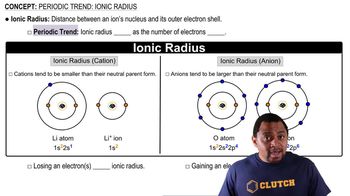
Ionic radius refers to the size of an ion in a crystal lattice. Cations, which are positively charged ions, are generally smaller than their neutral atoms due to the loss of electrons, which reduces electron-electron repulsion and allows the remaining electrons to be pulled closer to the nucleus. The ionic radius can vary significantly depending on the charge of the ion.
The charge of an ion directly affects its size. For cations, an increase in positive charge typically leads to a decrease in size. This is because a higher positive charge results in a stronger attraction between the nucleus and the remaining electrons, pulling them closer and reducing the overall size of the ion.
In the case of chromium ions, Cr3+ has a +3 charge while Cr6+ has a +6 charge. Given the principles of ionic radius and charge, Cr3+ will be larger than Cr6+ because the lower positive charge of Cr3+ results in less nuclear attraction on the remaining electrons, allowing for a larger ionic size compared to the more highly charged Cr6+.

 McMurry 8th Edition
 Verified step by step guidance
 02:47
02:47