Ch.16 - Aqueous Equilibria: Acids & Bases
McMurry - Chemistry 8th Edition
McMurry8th EditionChemistryISBN: 9781292336145Not the one you use?Change textbook
Chapter 16, Problem 16-145

What is the pH and the principal source of H3O+ ions in 1.0 * 10-10 M HCl? (Hint: The pH of an acid solution can’t exceed 7.) What is the pH of 1.0 * 10-7 M HCl?

Verified step by step guidance
1
Start by understanding that the pH is a measure of the concentration of hydronium ions \([\text{H}_3\text{O}^+]\) in a solution. The formula for pH is \(\text{pH} = -\log[\text{H}_3\text{O}^+]\).
For a very dilute solution of HCl, such as \(1.0 \times 10^{-10}\, \text{M}\), the concentration of \([\text{H}_3\text{O}^+]\) from the ionization of water (\(1.0 \times 10^{-7}\, \text{M}\)) is significant compared to the concentration of \([\text{H}_3\text{O}^+]\) from the acid.
Recognize that in such dilute solutions, the principal source of \([\text{H}_3\text{O}^+]\) is actually the autoionization of water, not the acid itself.
For \(1.0 \times 10^{-7}\, \text{M}\) HCl, the concentration of \([\text{H}_3\text{O}^+]\) from the acid is equal to the concentration from the autoionization of water, so the total \([\text{H}_3\text{O}^+]\) is \(2.0 \times 10^{-7}\, \text{M}\).
Calculate the pH for both solutions using the formula \(\text{pH} = -\log[\text{H}_3\text{O}^+]\), keeping in mind that the pH of an acidic solution cannot exceed 7.>

Verified video answer for a similar problem:

This video solution was recommended by our tutors as helpful for the problem above.
Video duration:
8m

Key Concepts

Here are the essential concepts you must grasp in order to answer the question correctly.

pH Scale

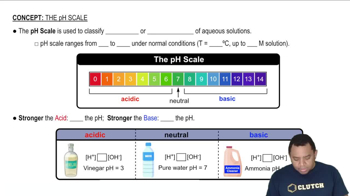
The pH scale measures the acidity or basicity of a solution, ranging from 0 to 14. A pH of 7 is neutral, while values below 7 indicate acidity and above 7 indicate basicity. The pH is calculated as the negative logarithm of the hydrogen ion concentration, pH = -log[H+]. Understanding this scale is crucial for determining the acidity of solutions like HCl.
Recommended video:

Hydrochloric Acid (HCl) Dissociation

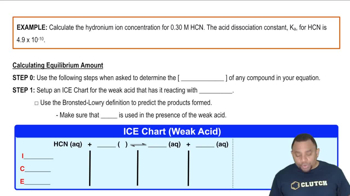
Hydrochloric acid (HCl) is a strong acid that completely dissociates in water to produce H3O+ ions and Cl- ions. The concentration of H3O+ ions directly influences the pH of the solution. In very dilute solutions, such as 1.0 * 10^-10 M HCl, the contribution of H3O+ from water itself (1.0 * 10^-7 M) must also be considered when calculating the overall pH.
Recommended video:
Guided course
00:54
Acid-Base Dissociation Example

Contributions to H3O+ Concentration

In dilute acid solutions, the concentration of H3O+ ions from the acid must be compared to the autoionization of water, which contributes 1.0 * 10^-7 M H3O+. For 1.0 * 10^-10 M HCl, the total H3O+ concentration is dominated by the water's contribution, leading to a pH that is still around 7. This concept is essential for understanding how very dilute acids behave in solution.
Recommended video:
Guided course
06:25
Hydronium Ion Concentration Example