
Ch.9 - Thermochemistry: Chemical Energy
McMurry - Chemistry 8th Edition
McMurry8th EditionChemistryISBN: 9781292336145Not the one you use?Change textbook
Chapter 9, Problem 153b

(b) Use the data in Appendix B to calculate ΔH° for the reaction of potassium metal with water.

Verified step by step guidance
1
Identify the balanced chemical equation for the reaction of potassium metal with water. The reaction is typically: \(2K(s) + 2H_2O(l) \rightarrow 2KOH(aq) + H_2(g)\).
Look up the standard enthalpy of formation (\(\Delta H_f^\circ\)) values for each reactant and product in the reaction from Appendix B. You will need the values for \(K(s)\), \(H_2O(l)\), \(KOH(aq)\), and \(H_2(g)\).
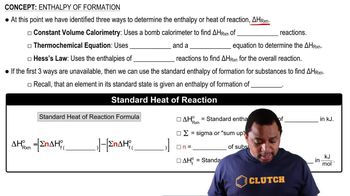
Apply Hess's Law which states that the total enthalpy change for a reaction is the sum of the enthalpy changes for each step of the reaction, regardless of the path taken. For this reaction, calculate \(\Delta H^\circ_{reaction}\) using the formula: \(\Delta H^\circ_{reaction} = \sum (\Delta H_f^\circ \text{ of products}) - \sum (\Delta H_f^\circ \text{ of reactants})\).
Multiply the \(\Delta H_f^\circ\) of each substance by its respective coefficient in the balanced chemical equation.
Sum up all the values obtained in the previous step to find the total \(\Delta H^\circ_{reaction}\) for the reaction of potassium metal with water.

Verified video answer for a similar problem:

This video solution was recommended by our tutors as helpful for the problem above.
Video duration:
3m
Was this helpful?

Key Concepts

Here are the essential concepts you must grasp in order to answer the question correctly.

Enthalpy Change (ΔH°)

Enthalpy change, denoted as ΔH°, refers to the heat content change of a system at constant pressure during a chemical reaction. It indicates whether a reaction is exothermic (releases heat, ΔH° < 0) or endothermic (absorbs heat, ΔH° > 0). Understanding how to calculate ΔH° is crucial for predicting the energy changes associated with chemical reactions.
Recommended video:
Guided course
02:34
Enthalpy of Formation

Standard State Conditions

Standard state conditions refer to the specific set of conditions (1 atm pressure, 25°C temperature) under which the standard enthalpy of formation and other thermodynamic properties are measured. These conditions provide a reference point for comparing the enthalpy changes of different reactions, ensuring consistency in calculations and interpretations.
Recommended video:
Guided course
01:10
Standard Reduction Potentials

Hess's Law

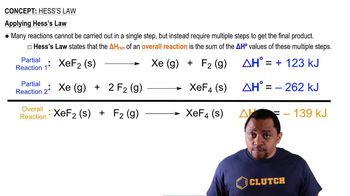
Hess's Law states that the total enthalpy change for a reaction is the sum of the enthalpy changes for individual steps of the reaction, regardless of the pathway taken. This principle allows chemists to calculate ΔH° for complex reactions by using known enthalpy values from simpler reactions, facilitating the determination of energy changes in multi-step processes.
Recommended video:
Related Practice
Textbook Question

Acid spills are often neutralized with sodium carbonate or sodium hydrogen carbonate. For neutralization of acetic acid, the unbalanced equations are

(1) CH3CO2H(l) + Na2CO3(s) → CH3CO2Na(aq) + CO2(g) + H2O(l)

(2) CH3CO2H(l) + NaHCO3(s) → CH3CO2Na(aq) + CO2(g) + H2O(l)

(a) Balance both equations.

Textbook Question

Acid spills are often neutralized with sodium carbonate or sodium hydrogen carbonate. For neutralization of acetic acid, the unbalanced equations are

(1) CH3CO2H(l) + Na2CO3(s) → CH3CO2Na(aq) + CO2(g) + H2O(l)

(2) CH3CO2H(l) + NaHCO3(s) → CH3CO2Na(aq) + CO2(g) + H2O(l)

(b) How many kilograms of each substance is needed to neutralize a 1.000-gallon spill of pure acetic acid (density = 1.049 g/mL)?

Textbook Question

(d) What is the molarity of the KOH solution prepared in part (c), and how many milliliters of 0.554 M H2SO4 are required to neutralize it?

Textbook Question

(c) Assume that a chunk of potassium weighing 7.55 g is dropped into 400.0 g of water at 25.0 °C. What is the final temperature of the water if all the heat released is used to warm the water?

Textbook Question
Hydrazine, a component of rocket fuel, undergoes combus- tion to yield N2 and H2O:N2H41l2 + O21g2 S N21g2 + 2 H2O1l2 (b) Use the following information to set up a Hess's law cycle, and then calculate ΔH° for the combustion reac- tion. You will need to use fractional coefficients for some equations. 2 NH31g2 + 3 N2O1g2 S 4 N21g2 + 3 H2O1l2 ΔH° = - 1011.2 kJ N2O1g2 + 3 H21g2 S N2H41l2 + H2O1l2 ΔH° = - 317.2 kJ 4 NH31g2 + O21g2 S 2 N2H41l2 + 2 H2O1l2 ΔH° = - 286.0 kJ H2O1l2 ΔH°f = - 285.8 kJ>mol
1
views
Textbook Question

(a) Write a balanced equation for the reaction of potassium metal with water.