The following reaction is exothermic: (c) Is the reaction likely to be spontaneous at lower temperatures only, at higher temperatures only, or at all temperatures?
Ch.9 - Thermochemistry: Chemical Energy
Chapter 9, Problem 39
Acetylene, C2H2, reacts with H2 in two steps to yield ethane, CH3CH3:(1) HC?CH + H2 → H2C?CH2 ΔH° = -175.1 kJ(2) H2C?CH2 + H2 → CH3CH3 ΔH° = -136.3 kJWhich arrow (a–c) in the Hess's law diagram corresponds to which step, an2d which a2rrow cor2responds to the net reaction? Where are the reactants located on the diagram, and where are the products located?
Verified step by step guidance1
Identify the given reactions and their enthalpy changes: (1) HC≡CH + H2 → H2C=CH2 with ΔH° = -175.1 kJ and (2) H2C=CH2 + H2 → CH3CH3 with ΔH° = -136.3 kJ.
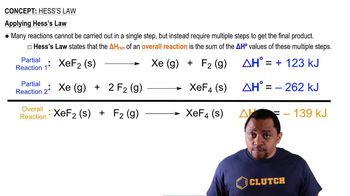
Understand that the Hess's law diagram represents the enthalpy changes of these reactions. The arrows indicate the direction and magnitude of the enthalpy changes.
Determine which arrow corresponds to each reaction step: The first reaction (HC≡CH + H2 → H2C=CH2) has a larger enthalpy change (-175.1 kJ) compared to the second reaction (H2C=CH2 + H2 → CH3CH3) with -136.3 kJ.
Match the arrows to the reactions: The blue arrow (a) represents the first reaction step with the larger enthalpy change, and the green arrow (b) represents the second reaction step with the smaller enthalpy change.
Identify the net reaction and its corresponding arrow: The net reaction is HC≡CH + 2H2 → CH3CH3, and the gray arrow (c) represents the total enthalpy change of the net reaction, which is the sum of the enthalpy changes of the two steps.

Verified video answer for a similar problem:
This video solution was recommended by our tutors as helpful for the problem above.
Video duration:
3mWas this helpful?
Key Concepts
Here are the essential concepts you must grasp in order to answer the question correctly.
Hess's Law
Hess's Law states that the total enthalpy change for a chemical reaction is the sum of the enthalpy changes for each step of the reaction, regardless of the pathway taken. This principle allows chemists to calculate the enthalpy change of a reaction that may occur in multiple steps by using known enthalpy changes of individual steps.
Recommended video:
Guided course
Hess's Law
Enthalpy Change (ΔH)
Enthalpy change (ΔH) is a measure of the heat content of a system at constant pressure. A negative ΔH indicates that the reaction is exothermic, releasing heat to the surroundings, while a positive ΔH indicates an endothermic reaction, absorbing heat. In the context of the question, the ΔH values for each step indicate the energy released during the formation of ethylene and ethane from acetylene.
Recommended video:
Guided course
Enthalpy of Formation
Reaction Diagram
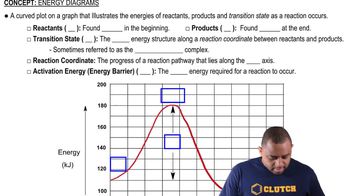
A reaction diagram visually represents the progress of a chemical reaction, showing the reactants, products, and the energy changes associated with each step. In the context of the question, the diagram illustrates the two-step process of converting acetylene to ethane, with arrows indicating the direction of energy change for each step and the overall reaction, helping to identify the corresponding steps in the Hess's Law framework.
Recommended video:
Guided course
Energy Diagrams
Related Practice
Textbook Question
Textbook Question
The reaction of A with B to give D proceeds in two steps: (1) A + B → C ΔH° = -20 kJ (2) C + B → D ΔH° = +50 kJ (3) A + 2B → D ΔH° = ? (b) What is the value of ΔH° for the overall reaction A + 2 B → D ΔH° = ?
Textbook Question
The following reaction is exothermic:
(a) Write a balanced equation for the reaction (red spheres represent A atoms and ivory spheres represent B atoms)
Textbook Question
The reaction of A with B to give D proceeds in two steps: (1) A + B → C ΔH° = -20 kJ (2) C + B → D ΔH° = +50 kJ (3) A + 2B → D ΔH° = ? (a) Which Hess's law diagram represents the reaction steps and the overall reaction? Diagram 1 Diagram 2
Textbook Question
A reaction is carried out in a cylinder fitted with a movable piston. The starting volume is V = 5.00 L, and the appa- ratus is held at constant temperature and pressure. Assum- ing that ∆H = -35.0 kJ and ∆E = -34.8 kJ, redraw the piston to show its position after reaction. Does V increase,decrease, or remain the same?
Textbook Question
The following reaction of A3 molecules is spontaneous. (a) Write a balanced equation for the reaction.