Sodium nitrite, NaNO2, is frequently added to processed meats as a preservative. The amount of nitrite ion in a sample can be determined by acidifying to form nitrous acid (HNO2), letting the nitrous acid react with an excess of iodide ion, and then titrating the I3 - ion that results with thiosulfate solution in the presence of a starch indicator. The unbalanced equations are (1) (2) (a) Balance the two redox equations.
To 100.0 mL of a solution that contains 0.120 M Cr(NO3)2 and 0.500 M HNO3 is added to 20.0 mL of 0.250 M K2Cr2O7. The dichromate and chromium(II) ions react to give chromium(III) ions. (a) Write a balanced net ionic equation for the reaction.
Verified step by step guidance
Verified video answer for a similar problem:
Key Concepts
Net Ionic Equations
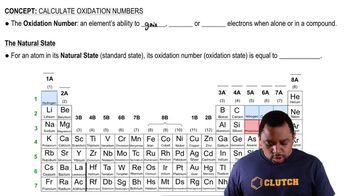
Oxidation States
Stoichiometry of Reactions
Element M is prepared industrially by a two-step procedure according to the following (unbalanced) equations:
Assume that 0.855 g of M2O3 is submitted to the reaction sequence. When the HCl produced in step (2) is dissolved in water and titrated with 0.511 M NaOH, 144.2 mL of the NaOH solution is required to neutralize the HCl. (a) Balance both equations.
Sodium nitrite, NaNO2, is frequently added to processed meats as a preservative. The amount of nitrite ion in a sample can be determined by acidifying to form nitrous acid (HNO2), letting the nitrous acid react with an excess of iodide ion, and then titrating the I3 - ion that results with thiosulfate solution in the presence of a starch indicator. The unbalanced equations are (1) (2) (b) When a nitrite-containing sample with a mass of 2.935 g was analyzed, 18.77 mL of 0.1500 M Na2S2O3 solution was needed for the reaction. What is the mass percent of NO2- ion in the sample?
(b) Calculate the concentrations of all ions in the solution after reaction. Check your concentrations to make sure that the solution is electrically neutral.
