Box (a) represents 1.0 mL of a solution of particles at a given concentration. Which of the boxes (b)–(d) represents 1.0 mL of the solution that results after (a) has been diluted by doubling the volume of its solvent? (a) (b) (c) (d)
Verified step by step guidance
1
Step 1: Understand the concept of dilution. Dilution involves adding more solvent to a solution, which decreases the concentration of the solute. The total amount of solute remains the same, but it is spread out over a larger volume.
Step 2: Identify the initial conditions. Box (a) represents 1.0 mL of a solution at a certain concentration. This is your starting point before dilution.
Step 3: Determine the effect of doubling the volume. Doubling the volume of the solvent means the final volume will be 2.0 mL. The concentration of the solution will be halved because the same amount of solute is now in a larger volume.
Step 4: Visualize the particle distribution. In the diluted solution, the particles will be more spread out compared to the original solution in box (a).
Step 5: Compare the options. Look at boxes (b), (c), and (d) to identify which one shows particles that are half as concentrated as in box (a), indicating the correct representation of the diluted solution.
Verified video answer for a similar problem:
This video solution was recommended by our tutors as helpful for the problem above.
Video duration:
2m
Play a video:
0 Comments
Was this helpful?
Key Concepts
Here are the essential concepts you must grasp in order to answer the question correctly.
Dilution
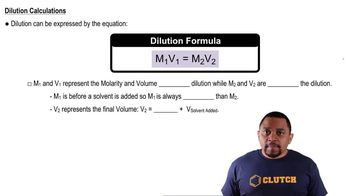
Dilution is the process of reducing the concentration of a solute in a solution, typically by adding more solvent. When a solution is diluted, the number of solute particles remains the same, but the total volume increases, leading to a lower concentration. For example, if you have 1.0 mL of a solution and you double the volume by adding 1.0 mL of solvent, the concentration of the solute is halved.
Concentration refers to the amount of solute present in a given volume of solution. It is often expressed in units such as molarity (moles per liter) or mass/volume percent. Understanding concentration is crucial for predicting how changes in volume, such as dilution, will affect the properties of the solution, including its reactivity and behavior in chemical reactions.
The relationship between volume and solvent in a solution is fundamental to understanding how dilution affects concentration. When the volume of solvent is increased, the solute is spread over a larger volume, which decreases its concentration. This principle is essential for solving problems related to mixing solutions and predicting the outcomes of chemical processes involving solutions.