Calculate the mass percent composition of each of the following substances. (a) Malachite, a copper-containing mineral: Cu2(OH)2CO3
Ch.3 - Mass Relationships in Chemical Reactions
Chapter 3, Problem 87b
Calculate the mass percent composition of each of the following substances. (b) Acetaminophen, a headache remedy: C8H9NO2
Verified step by step guidance1
Identify the molecular formula of acetaminophen: \( \text{C}_8\text{H}_9\text{NO}_2 \).
Calculate the molar mass of each element in the compound: Carbon (C), Hydrogen (H), Nitrogen (N), and Oxygen (O).
Determine the total molar mass of acetaminophen by summing the molar masses of all atoms in the formula.
Calculate the mass percent of each element by dividing the total mass of each element by the total molar mass of the compound and multiplying by 100%.
Express the mass percent composition for each element: Carbon, Hydrogen, Nitrogen, and Oxygen.

Verified video answer for a similar problem:
This video solution was recommended by our tutors as helpful for the problem above.
Video duration:
2mWas this helpful?
Key Concepts
Here are the essential concepts you must grasp in order to answer the question correctly.
Molar Mass Calculation
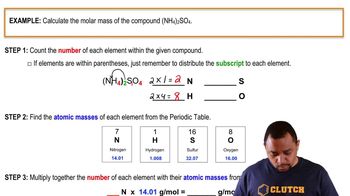
Molar mass is the mass of one mole of a substance, typically expressed in grams per mole (g/mol). To calculate the molar mass of a compound, sum the atomic masses of all the atoms in its molecular formula. For acetaminophen (C8H9NO2), this involves multiplying the number of each type of atom by its respective atomic mass and adding these values together.
Recommended video:
Guided course
Molar Mass Calculation Example
Mass Percent Composition
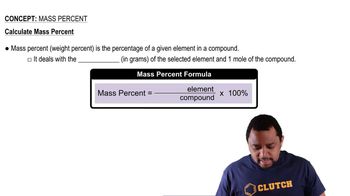
Mass percent composition refers to the percentage by mass of each element in a compound. It is calculated by dividing the mass of each element in one mole of the compound by the total molar mass of the compound, then multiplying by 100. This provides insight into the relative abundance of each element within the compound.
Recommended video:
Guided course
Mass Percent Calculation
Empirical and Molecular Formulas
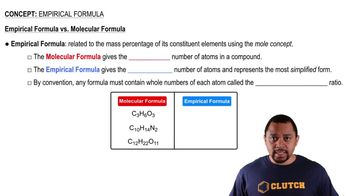
The empirical formula represents the simplest whole-number ratio of elements in a compound, while the molecular formula shows the actual number of atoms of each element in a molecule. Understanding the difference is crucial when calculating mass percent composition, as the molecular formula of acetaminophen (C8H9NO2) directly informs the molar mass and subsequent calculations for mass percent.
Recommended video:
Guided course
Empirical vs Molecular Formula
Related Practice
Textbook Question
Textbook Question
Calculate the mass percent composition of each of the following substances. (c) Prussian blue, an ink pigment: Fe4[Fe(CN)6]3
Textbook Question
Sodium borohydride, NaBH4, a substance used in the synthesis of many pharmaceutical agents, can be prepared by reaction of NaH with B2H6 according to the equation 2 NaH + B2H6 → 2 NaBH4
(b) Which reactant is limiting, and how many grams of the excess reactant will be left over?
Textbook Question
What are the empirical formulas of substances with the following mass percent compositions? (b) Ilmenite (a titanium-containing ore): 31.63% O, 31.56% Ti, 36.81% Fe
Textbook Question
Urea, a substance commonly used as a fertilizer, has the for-mula CH4N2O. What is its percent composition by mass?
Textbook Question
What are the empirical formulas of substances with the following mass percent compositions? (a) Aspirin: 4.48% H, 60.00% C, 35.52% O