Balance the following equations. (c) S + O2 → SO3
Ch.3 - Mass Relationships in Chemical Reactions
Chapter 3, Problem 38b
Balance the following equations. (b) CaC2 + H2O → Ca(OH)2 + C2H2
Verified step by step guidance1
Identify the number of each type of atom on both sides of the equation: Ca, C, H, and O.
Start by balancing the atoms that appear in the fewest compounds. In this case, balance the calcium (Ca) atoms first.
Next, balance the carbon (C) atoms. There are 2 carbon atoms in C_2H_2, so ensure there are 2 carbon atoms on the reactant side.
Balance the hydrogen (H) atoms. There are 2 hydrogen atoms in H_2O and 2 in C_2H_2, so adjust the coefficients to balance the hydrogen atoms.
Finally, balance the oxygen (O) atoms. There are 2 oxygen atoms in Ca(OH)_2, so ensure the same number of oxygen atoms on the reactant side.

Verified video answer for a similar problem:
This video solution was recommended by our tutors as helpful for the problem above.
Video duration:
1mWas this helpful?
Key Concepts
Here are the essential concepts you must grasp in order to answer the question correctly.
Balancing Chemical Equations
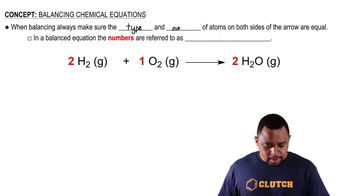
Balancing chemical equations involves ensuring that the number of atoms of each element is the same on both sides of the equation. This is based on the law of conservation of mass, which states that matter cannot be created or destroyed in a chemical reaction. Coefficients are used to adjust the quantities of reactants and products to achieve balance.
Recommended video:
Guided course
Balancing Chemical Equations
Stoichiometry
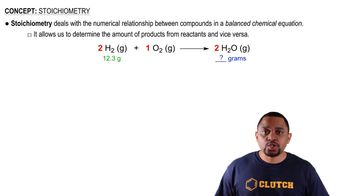
Stoichiometry is the calculation of reactants and products in chemical reactions. It allows chemists to predict the amounts of substances consumed and produced in a reaction based on balanced equations. Understanding stoichiometry is essential for accurately balancing equations and determining the relationships between different compounds.
Recommended video:
Guided course
Stoichiometry Concept
Types of Chemical Reactions
Chemical reactions can be classified into several types, including synthesis, decomposition, single replacement, and double replacement. The reaction between calcium carbide (CaC2) and water (H2O) is a type of double replacement reaction, where the components of the reactants exchange partners. Recognizing the type of reaction helps in predicting the products and balancing the equation.
Recommended video:
Guided course
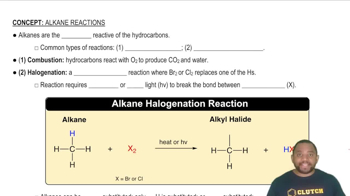
Common Types of Alkane Reactions
Related Practice
Textbook Question
Textbook Question
Balance the following equations. (d) UO2 + HF → UF4 + H2O
Textbook Question
Balance the following equations. (a) Mg + HNO3 → H2 + Mg(NO3)2
Textbook Question
Which of the following equations is balanced?
(a) The development reaction in silver-halide photography: 2 AgBr + 2 NaOH + C6H6O2 → 2 Ag + H2O + 2 NaBr + C6H4O2
(b) The preparation of household bleach: 2 NaOH + Cl2 → NaOCl + NaCl + H2O
Textbook Question
Which of the following equations is balanced? Balance any that need it.
(a) The thermite reaction, used in welding: Al + Fe2O3 → Al2O3 + Fe
(b) The photosynthesis of glucose from CO2: 6 CO2 + 6 H2O → C6H12O6 + 6 O2
(c) The separation of gold from its ore: Au + 2 NaCN + O2 + H2O → NaAu(CN)2 + 3 NaOH
Textbook Question
Balance the following equations. (a) The explosion of ammonium nitrate: NH4NO3 → N2 + O2 + H2O