How many grams of each product result from the following reactions, and how many grams of which reactant is left over? (a)
Ch.3 - Mass Relationships in Chemical Reactions
Chapter 3, Problem 74
Assume that you have 1.39 mol of H2 and 3.44 mol of N2. How many grams of ammonia (NH3) can you make, and how many grams of which reactant will be left over?3 H2 + N2 --> NH3
Verified step by step guidance1
Identify the balanced chemical equation: \(3 \text{H}_2 + \text{N}_2 \rightarrow 2 \text{NH}_3\).
Determine the limiting reactant by comparing the mole ratio of \(\text{H}_2\) and \(\text{N}_2\) to the stoichiometric coefficients in the balanced equation.
Calculate the theoretical yield of \(\text{NH}_3\) in moles using the limiting reactant.
Convert the moles of \(\text{NH}_3\) to grams using the molar mass of \(\text{NH}_3\) (17.03 g/mol).
Calculate the amount of the excess reactant left over by subtracting the amount used from the initial amount.

Verified video answer for a similar problem:
This video solution was recommended by our tutors as helpful for the problem above.
Video duration:
5mWas this helpful?
Key Concepts
Here are the essential concepts you must grasp in order to answer the question correctly.
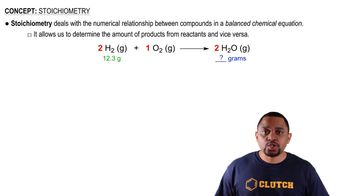
Stoichiometry
Stoichiometry is the branch of chemistry that deals with the quantitative relationships between the reactants and products in a chemical reaction. It allows us to calculate the amounts of substances consumed and produced in a reaction based on balanced chemical equations. In this case, the stoichiometric coefficients indicate that 3 moles of H2 react with 1 mole of N2 to produce 2 moles of NH3.
Recommended video:
Guided course
Stoichiometry Concept
Limiting Reactant
The limiting reactant is the substance that is completely consumed first in a chemical reaction, thus determining the maximum amount of product that can be formed. To identify the limiting reactant, we compare the mole ratios of the reactants used in the reaction to the amounts available. In this scenario, we will need to determine whether H2 or N2 limits the production of NH3.
Recommended video:
Guided course
Limiting Reagent Concept
Molar Mass
Molar mass is the mass of one mole of a substance, typically expressed in grams per mole (g/mol). It is essential for converting between moles and grams when calculating the amounts of reactants and products. For ammonia (NH3), the molar mass is approximately 17.03 g/mol, which will be used to convert the moles of NH3 produced into grams and to determine the leftover reactants.
Recommended video:
Guided course
Molar Mass Concept
Related Practice
Textbook Question
Textbook Question
Nickel(II) sulfate, used for nickel plating, is prepared by treat-ment of nickel(II) carbonate with sulfuric acid: NiCO3 + H2SO4 → NiSO4 + CO2 + H2O
(b) How many grams of NiSO4 are obtained if the yield is 78.9%?
1
views
Textbook Question
Hydrogen and chlorine react to yield hydrogen chloride: H2 + Cl2 ¡ 2 HCl. How many grams of HCl are formed from reaction of 3.56 g of H2 with 8.94 g of Cl2? Which reactant is limiting?
Textbook Question
Hydrazine, N2H4, once used as a rocket propellant, reacts with oxygen: N2H4 + O2 → N2 + 2 H2O (a) How many grams of O2 are needed to react with 50.0 g of N2H4?
Textbook Question
Hydrazine, N2H4, once used as a rocket propellant, reacts with oxygen: N2H4 + O2 → N2 + 2 H2O (b) How many grams of N2 are obtained if the yield is 85.5%?
Textbook Question
How many grams of the dry-cleaning solvent 1,2-dichloroethane (also called ethylene chloride), C2H4Cl2, can be prepared by reaction of 15.4 g of ethylene, C2H4, with 3.74 g of Cl2?