a. Why is the SO3 molecule trigonal planar but the SO32– ion is trigonal pyramidal?

Ch.22 - The Main Group Elements
Chapter 22, Problem 22.41a
Which compound in each of the following pairs is more covalent?
(a) PCl3 or AlF3
Verified step by step guidance1
Identify the types of bonds present in each compound. PCl₃ and AlF₃ both have polar covalent bonds, but the degree of covalency can differ.
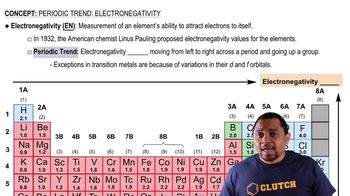
Consider the electronegativity difference between the atoms in each compound. A smaller difference in electronegativity generally indicates a more covalent character.
For PCl₃, compare the electronegativity of phosphorus (P) and chlorine (Cl).
For AlF₃, compare the electronegativity of aluminum (Al) and fluorine (F).
Determine which compound has a smaller electronegativity difference, indicating a more covalent character.

Verified video answer for a similar problem:
This video solution was recommended by our tutors as helpful for the problem above.
Was this helpful?
Key Concepts
Here are the essential concepts you must grasp in order to answer the question correctly.
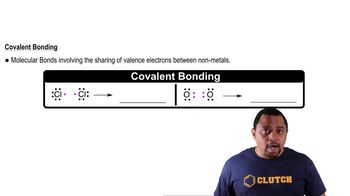
Covalent Bonding
Covalent bonding occurs when two atoms share electrons to achieve a full outer shell, typically between nonmetals. The degree of covalency can vary based on the electronegativity of the atoms involved; the greater the difference in electronegativity, the more ionic the bond becomes. In this context, understanding how covalent bonds form helps in comparing the compounds.
Recommended video:
Guided course
Chemical Bonds
Electronegativity
Electronegativity is a measure of an atom's ability to attract and hold onto electrons in a bond. Elements with similar electronegativities tend to form more covalent bonds, while a large difference indicates a more ionic character. By comparing the electronegativities of phosphorus, chlorine, aluminum, and fluorine, one can determine which compound is more covalent.
Recommended video:
Guided course
Electronegativity Trends
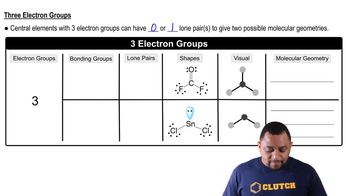
Molecular Structure and Geometry
The molecular structure and geometry of a compound influence its bonding characteristics. For example, PCl3 has a trigonal pyramidal shape, while AlF3 has a more ionic lattice structure. Understanding these geometrical arrangements helps in predicting the nature of the bonds and the overall covalency of the compounds in question.
Recommended video:
Guided course
Molecular Geometry with Three Electron Groups
Related Practice
Textbook Question
Textbook Question
An important physiological reaction of nitric oxide (NO) is its interaction with the superoxide ion (O2–) to form the peroxynitrite ion (ONOO–).
a. Write electron-dot structures for NO, O2–, and ONOO–, and predict the O–N–O bond angle in ONOO–.
Textbook Question
Write a balanced net ionic equation for the reaction of the amphoteric oxide Ga2O3 with:
a. Aqueous sulfuric acid
Textbook Question
Write a balanced net ionic equation for the reaction of the amphoteric oxide ZnO with:
a. Hydrochloric acid
Textbook Question
Which element in each of the following pairs has more nonmetallic character?
(a) Se or Te
Textbook Question
The following pictures represent structures of the hydrides of four second-row elements:
(1)
(2)
(3)
(4)
(a) Which compound has the highest melting point?