
Textbook Question
The following models represent the structures of binary hydrides of second-row elements:
b. Draw an electron-dot structure for each hydride. For which hydride is there a problem in drawing the structure? Explain.
 Verified step by step guidance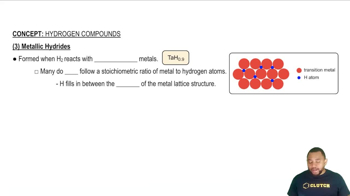
 01:00
01:00
 01:59
01:59 03:05
03:05The following models represent the structures of binary hydrides of second-row elements:
b. Draw an electron-dot structure for each hydride. For which hydride is there a problem in drawing the structure? Explain.
Consider the six second- and third-row elements in groups 4A–6A of the periodic table:
Possible structures for the binary fluorides of each of these elements in its highest oxidation state are shown below.
(a) Identify the nonfluorine atom in each case, and write the molecular formula of each fluoride.
The following pictures represent various silicate anions. Write the formula and charge of each anion.
Select the group 4A element that best fits each of the following descriptions.
b. Is the least dense semimetal
In the following pictures of binary hydrides, ivory spheres
represent H atoms or ions, and burgundy spheres represent
atoms or ions of the other element.
(1)
(2)
(3)
(4)
(a) Identify each binary hydride as ionic, covalent, or interstitial.
(b) What is the oxidation state of hydrogen in compounds (1), (2), and (3)? What is the oxidation state of the other
element?
Look at the location of elements A, B, C, and D in the following periodic table:
Which hydride has the lowest boiling point?