
Textbook Question
In octahedral complexes, the choice between high-spin and low-spin electron configurations arises only for d4 - d7 complexes. Explain.

 Verified step by step guidance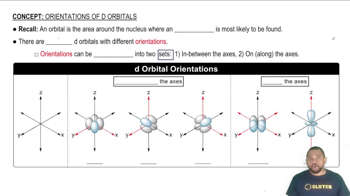
 02:06
02:06
 01:18
01:18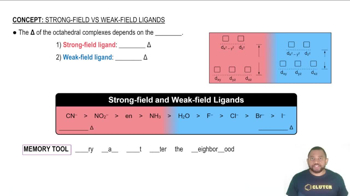 02:40
02:40In octahedral complexes, the choice between high-spin and low-spin electron configurations arises only for d4 - d7 complexes. Explain.
The reaction of the octahedral complex Co(NH3)3(NO2)3 with HCl yields a complex [Co(NH3)3(H2O)Cl2]+ in which the two chloride ligands are trans to one another.
(a) Draw the two possible stereoisomers of the starting material [Co(NH3)3(NO2)3]. (All three NO2- ligands are bonded to Co through the N atom.)
(b) Assuming that the NH3 groups remain in place, which of the two starting isomers could give rise to the observed product?
Consider the octahedral complex [Co(en)(dien)Cl]2+, where dien = H2NCH2CH2NHCH2CH2NH2, which can be abbreivated
(a) The dien (diethylenetriamine) ligand is a tridentate ligand. Explain what is meant by 'tridentate' and why dien can act as a tridentate ligand.
(b) Draw all possible stereoisomers of [Co(en)(dien)Cl]2+ (dien is a flexible ligand). Which stereoisomers are chiral, and which are achiral?
For each of the following, (i) give the systematic name of the compound and specify the oxidation state of the transition metal, (ii) draw a crystal field energy-level diagram and assign the d electrons to orbitals, (iii) indicate whether the complex is high-spin or low-spin (for d4 - d7 complexes), and (iv) specify the number of unpaired electrons.
(a) (NH4)[Cr(H2O)6](SO4)2