What common characteristics do elements within a group of the periodic table have?
Verified step by step guidance
1
Elements within the same group of the periodic table have the same number of valence electrons. This is a key characteristic that defines their chemical properties.
The similar number of valence electrons results in elements within a group having similar chemical reactivity. For example, elements in Group 1 (alkali metals) are highly reactive with water.
Elements in the same group often exhibit similar trends in physical properties, such as melting and boiling points, although these can vary more than chemical properties.
The elements in a group typically form ions with the same charge. For instance, Group 1 elements form +1 ions, while Group 17 elements form -1 ions.
The atomic radius generally increases as you move down a group due to the addition of electron shells, which can affect the reactivity and other properties of the elements.
Verified video answer for a similar problem:
This video solution was recommended by our tutors as helpful for the problem above.
Video duration:
1m
Play a video:
0 Comments
Was this helpful?
Key Concepts
Here are the essential concepts you must grasp in order to answer the question correctly.
Periodic Table Groups
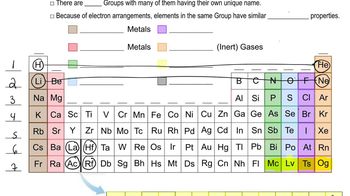
Elements in the same group of the periodic table share similar chemical properties due to their similar valence electron configurations. For example, Group 1 elements, known as alkali metals, all have one electron in their outermost shell, which leads to comparable reactivity and bonding behavior.
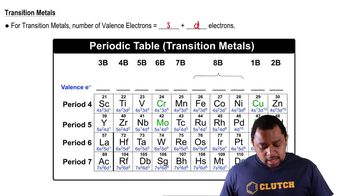
Valence electrons are the electrons in the outermost shell of an atom and play a crucial role in determining an element's chemical properties and reactivity. Elements within the same group have the same number of valence electrons, which influences how they interact with other elements and form compounds.
Chemical reactivity refers to how readily an element undergoes chemical reactions, which is largely influenced by its electron configuration. Elements in the same group often exhibit similar reactivity patterns; for instance, halogens in Group 17 are highly reactive nonmetals, while noble gases in Group 18 are largely inert due to their full valence electron shells.