The reaction of MnO4– with oxalic acid (H2C2O4) in acidic solution, yielding Mn2+ and CO2 gas, is widely used to determine the concentration of permanganate solutions. (b) Use the data in Appendix D to calculate E° for the reaction. (c) Show that the reaction goes to completion by calculating the values of ∆G° and K at 25 °C. (H2C2O4) in acidic solution, yielding Mn2+ and CO2 gas, is widely used to determine the concentration of permanganate solutions.
Given the following standard reduction potentials at 25 °C, (a) balance the equation for the reaction of H2MoO4 with elemental arsenic in acidic solution to give Mo3+ and H3AsO4 and (b) calculate E° for this reaction.
Verified step by step guidance
Verified video answer for a similar problem:
Key Concepts
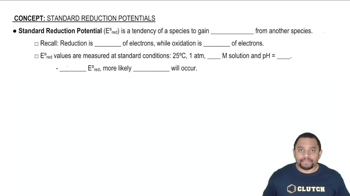
Standard Reduction Potentials
Balancing Redox Reactions
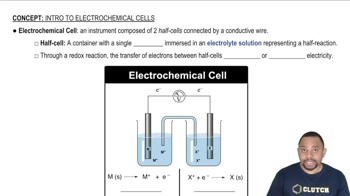
Electrochemical Cell Potential
Chlorine can be prepared in the laboratory by the reaction of hydrochloric acid and potassium permanganate. (a) Use data in Appendix D to write a balanced equation for the reaction. The reduction product is Mn2+.
The reaction of MnO4– with oxalic acid (H2C2O4) in acidic solution, yielding Mn2+ and CO2 gas, is widely used to determine the concentration of permanganate solutions. (a) Write a balanced net ionic equation for the reaction.
The reaction of MnO4– with oxalic acid (H2C2O4) in acidic solution, yielding Mn2+ and CO2 gas, is widely used to determine the concentration of permanganate solutions. (d) A 1.200 g sample of sodium oxalate (Na2C2O4) is dissolved in dilute H2SO4 and then titrated with a KMnO4 solution. If 32.50 mL of the KMnO4 solution is required to reach the equivalence point, what is the molarity of the KMnO4 solution?
