The hydronium ion H3O+ is the strongest acid that can exist
in aqueous solution because stronger acids dissociate by
transferring a proton to water. What is the strongest base
that can exist in aqueous solution?
Verified step by step guidance
1
Understand the concept of acid and base strength in water: Strong acids in water donate a proton to water molecules, forming hydronium ions (H3O+).
Recognize that the strength of a base in water is determined by its ability to accept a proton from water, forming hydroxide ions (OH-).
Identify that the strongest base that can exist in aqueous solution is the one that can completely deprotonate water to form hydroxide ions.
Consider the autoionization of water: Water can act as both an acid and a base. When it acts as an acid, it donates a proton to a base, forming OH-.
Conclude that the hydroxide ion (OH-) is the strongest base that can exist in aqueous solution, as it results from the complete deprotonation of water.
Verified video answer for a similar problem:
This video solution was recommended by our tutors as helpful for the problem above.
Video duration:
2m
Play a video:
0 Comments
Was this helpful?
Key Concepts
Here are the essential concepts you must grasp in order to answer the question correctly.
Acid-Base Theory
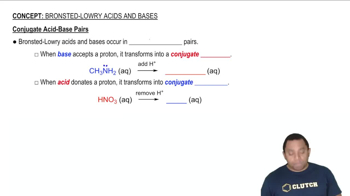
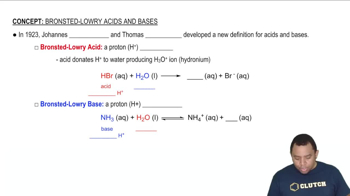
Acid-base theory explains the behavior of acids and bases in chemical reactions. According to the Brønsted-Lowry theory, acids are proton donors, while bases are proton acceptors. In aqueous solutions, the strength of an acid is determined by its ability to donate protons to water, forming hydronium ions (H3O+). This framework is essential for understanding the interactions between acids and bases in solution.
Dissociation refers to the process by which an acid breaks apart in solution to release protons. Strong acids, like HCl, completely dissociate in water, producing a high concentration of H3O+ ions. This complete dissociation is what makes them strong acids. Understanding this concept is crucial for identifying the strongest acid and, by extension, the strongest base that can exist in aqueous solution.
Conjugate acid-base pairs are related species that differ by the presence of a proton. When an acid donates a proton, it forms its conjugate base, while the base that accepts the proton becomes its conjugate acid. In the context of the question, the strongest base in aqueous solution is the conjugate base of the strongest acid, which is the hydroxide ion (OH-) since it can accept a proton to form water.

 Verified step by step guidance
 02:08
02:08