A 79.2 g chunk of dry ice (solid CO2) and 30.0 g of graphite (carbon) were placed in an empty 5.00-L container, and the mixture was heated to achieve equilibrium. The reaction isCO 1g2 + C s ∆ 2 CO g(b) What is the value of Kp at 1100 K if the gas density at 1100 K is 16.9 g/L?
Verified step by step guidance
Verified video answer for a similar problem:
Key Concepts
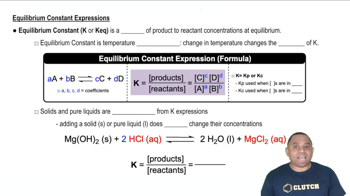
Equilibrium Constant (Kp)
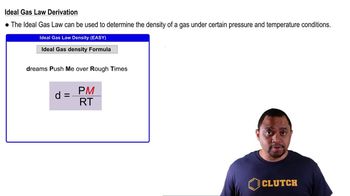
Gas Density and Ideal Gas Law
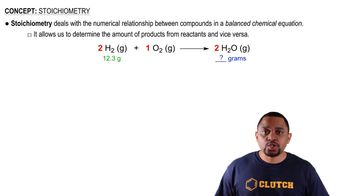
Stoichiometry of the Reaction
Consider the sublimation of mothballs at 27 °C in a room having dimensions 8.0 ft ⨉ 10.0 ft ⨉ 8.0 ft. Assume that the mothballs are pure solid naphthalene (density 1.16 g/cm3) and that they are spheres with a diameter of 12.0 mm. The equilibrium constant Kc for the sublimation of naphthalene is 5.40⨉10-6 at 27 °C. C10H8(s) ⇌ C10H8(g) (a) When excess mothballs are present, how many gaseous naphthalene molecules are in the room at equilibrium?
Acetic acid tends to form dimers, (CH3CO2H2), because of hydrogen bonding: The equilibrium constant Kc for this reaction is 1.51⨉102 in benzene solution but only 3.7⨉10-2 in water solution. (a) Calculate the ratio of dimers to monomers for 0.100 M acetic acid in benzene.
Acetic acid tends to form dimers, (CH3CO2H2), because of hydrogen bonding: The equilibrium constant Kc for this reaction is 1.51⨉102 in benzene solution but only 3.7⨉10-2 in water solution. (b) Calculate the ratio of dimers to monomers for 0.100 M acetic acid in water.
