
Textbook Question
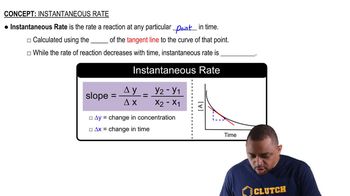
From the plot of concentration–time data in Figure 14.1, estimate: (b) the initial rate of decomposition of N2O5.
 Verified step by step guidance
 01:30
01:30
 02:03
02:03 02:40
02:40From the plot of concentration–time data in Figure 14.1, estimate: (b) the initial rate of decomposition of N2O5.
Consider a reaction that occurs by the following mechanism:
A + BC → AC + B
AC + D → A + CD
The potential energy profile for this reaction is as follows:
(d) Is the reaction endothermic or exothermic? Add labels to the diagram that show the values of the energy of reaction ΔE and the activation energy Ea for the overall reaction.
From a plot of the concentration–time data in Worked Example 14.9, estimate: (a) the instantaneous rate of decomposition of NO2 at t = 100 s.
From the plot of concentration–time data in Figure 14.1, estimate: (a) the instantaneous rate of decomposition of N2O5 at t = 200 s.
Consider a reaction that occurs by the following mechanism:
A + BC → AC + B
AC + D → A + CD
The potential energy profile for this reaction is as follows:
(c) Which of the two steps in the mechanism is the rate-determining step? Write the rate law for the overall reaction.