Ch.14 - Chemical Kinetics
McMurry - Chemistry 8th Edition
McMurry8th EditionChemistryISBN: 9781292336145Not the one you use?Change textbook
Chapter 14, Problem 143

At 791 K and relatively low pressures, the gas-phase decomposition of acetaldehyde (CH3CHO) is second order in acetaldehyde. CH3CHO(g) → CH4(g) + CO(g) The total pressure of a particular reaction mixture was found to vary as follows: (a) Use the pressure data to determine the value of the rate constant in units of atm⁻¹ s⁻¹. (b) What is the rate constant in the usual units of M⁻¹ s⁻¹?
Verified step by step guidance
1
Step 1: Recognize that the decomposition of acetaldehyde is a second-order reaction. For a second-order reaction, the rate law is given by \( \text{Rate} = k [\text{CH}_3\text{CHO}]^2 \), where \( k \) is the rate constant.
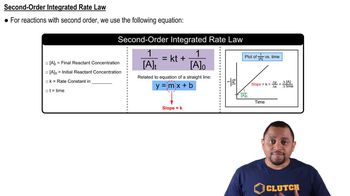
Step 2: Use the integrated rate law for a second-order reaction, which is \( \frac{1}{[A]_t} = \frac{1}{[A]_0} + kt \), where \([A]_t\) is the concentration at time \( t \), \([A]_0\) is the initial concentration, and \( k \) is the rate constant.
Step 3: Convert the pressure data to concentration data. Since the reaction occurs in the gas phase, you can use the ideal gas law \( PV = nRT \) to relate pressure to concentration. Assume constant temperature and volume to simplify calculations.
Step 4: Plot \( \frac{1}{[A]} \) versus time using the converted concentration data. The slope of this line will be equal to the rate constant \( k \) in units of atm⁻¹ s⁻¹.
Step 5: Convert the rate constant from atm⁻¹ s⁻¹ to M⁻¹ s⁻¹. Use the ideal gas law to find the conversion factor between atm and molarity (M), considering the temperature and volume conditions.

Key Concepts

Here are the essential concepts you must grasp in order to answer the question correctly.

Second-Order Reactions

A second-order reaction is one where the rate of reaction is proportional to the square of the concentration of one reactant or to the product of the concentrations of two reactants. For the decomposition of acetaldehyde, the rate law can be expressed as rate = k[CH3CHO]^2, where k is the rate constant. Understanding this concept is crucial for analyzing how changes in concentration affect the reaction rate and for calculating the rate constant from pressure data.
Recommended video:
Guided course
01:59
Second-Order Reactions

Pressure and Concentration Relationship

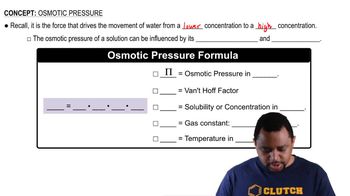
In gas-phase reactions, the total pressure of a mixture can be related to the concentrations of the gases involved through the ideal gas law (PV=nRT). For the decomposition of acetaldehyde, as it breaks down into methane and carbon monoxide, the change in total pressure reflects the change in the number of moles of gas. This relationship allows for the conversion of pressure data into concentration values, which is essential for determining the rate constant.
Recommended video:
Guided course
01:13
Osmotic Pressure Formula

Units of Rate Constants

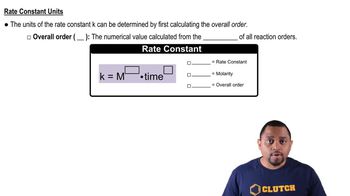
Rate constants have different units depending on the order of the reaction. For a second-order reaction, the rate constant k is expressed in units of M⁻¹ s⁻¹, where M is molarity. However, in the context of gas-phase reactions, pressure can be used instead of concentration, leading to units of atm⁻¹ s⁻¹. Understanding how to convert between these units is necessary for accurately reporting the rate constant in the required format.
Recommended video:
Guided course
00:45
Rate Constant Units
What is the rate law for the reaction? What is the numerical value of the rate constant k, including the correct units?
Textbook Question

The rate constant for the first-order decomposition of gaseous N2O5 to NO2 and O2 is 1.7 * 10-3 s-1 at 55 °C. (b) Use the data in Appendix B to calculate the initial rate at which the reaction mixture absorbs heat (in J/s). You may assume that the heat of the reaction is independent of temperature.