Which molecule has polar bonds but is nonpolar? (LO 8.6) (a) SF6 (b) SF2 (c) F2 (d) NF3
Verified step by step guidance
1
Step 1: Determine the polarity of the bonds in each molecule. A bond is polar if it is between two atoms with different electronegativities. In this case, SF6, SF2, and NF3 have polar bonds because Sulfur (S) and Nitrogen (N) have different electronegativities than Fluorine (F). F2 does not have a polar bond because both atoms are the same, so their electronegativities are equal.
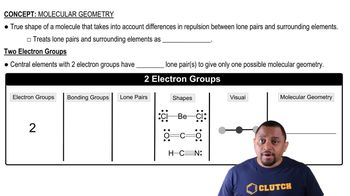
Step 2: Determine the molecular geometry of each molecule. The molecular geometry can be determined by the VSEPR theory, which states that electron pairs around a central atom will arrange themselves as far apart as possible to minimize repulsion. SF6 has an octahedral shape, SF2 has a bent shape, and NF3 has a trigonal pyramidal shape.
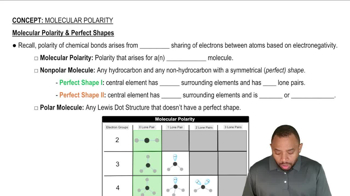
Step 3: Determine the overall polarity of the molecule. A molecule is nonpolar if the dipole moments of its bonds cancel out. This happens when the molecule is symmetrical. In this case, SF6 is nonpolar because its octahedral shape is symmetrical, so the dipole moments of the S-F bonds cancel out. SF2 and NF3 are polar because their shapes (bent and trigonal pyramidal, respectively) are not symmetrical, so the dipole moments of their bonds do not cancel out.
Step 4: Therefore, the molecule that has polar bonds but is nonpolar is SF6.
Verified video answer for a similar problem:
This video solution was recommended by our tutors as helpful for the problem above.
Video duration:
9m
Play a video:
0 Comments
Was this helpful?
Key Concepts
Here are the essential concepts you must grasp in order to answer the question correctly.
Polarity of Bonds
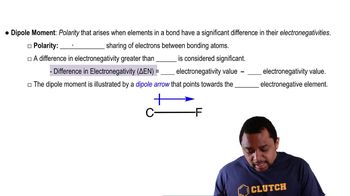
Polarity in chemical bonds arises from the difference in electronegativity between two atoms. When one atom is more electronegative, it attracts the shared electrons more strongly, creating a dipole moment. A bond is considered polar if this dipole moment is significant, leading to partial positive and negative charges on the atoms involved.
The three-dimensional arrangement of atoms in a molecule, known as molecular geometry, plays a crucial role in determining the overall polarity of the molecule. Even if a molecule contains polar bonds, its shape can lead to a cancellation of dipole moments, resulting in a nonpolar molecule. Common geometries include linear, trigonal planar, and tetrahedral.
The net dipole moment of a molecule is the vector sum of all individual dipole moments from its polar bonds. A molecule is classified as polar if it has a net dipole moment pointing in a specific direction. Conversely, if the dipole moments cancel each other out due to symmetry, the molecule is nonpolar, despite having polar bonds.