Isooctane, C8H18, is the component of gasoline from which the term octane rating derives. (b) Assuming that gasoline is 100% isooctane, that isooctane burns to produce only CO2 and H2O, and that the density of isooctane is 0.792 g/mL, what mass of CO2 in kilograms is produced each year by the annual U.S. gasoline consumption of 4.6⨉1010 L?
Isooctane, C8H18, is the component of gasoline from which the term octane rating derives. (d) How many moles of air are necessary for the combustion of 1 mol of isooctane, assuming that air is 21.0% O2 by volume? What is the volume in liters of this air at STP?
Verified step by step guidance
Verified video answer for a similar problem:
Key Concepts
Stoichiometry of Combustion Reactions
Composition of Air
Standard Temperature and Pressure (STP)
Isooctane, C8H18, is the component of gasoline from which the term octane rating derives. (a) Write a balanced equation for the combustion of isooctane to yield CO2 and H2O.
Chemical explosions are characterized by the instantaneous release of large quantities of hot gases, which set up a shock wave of enormous pressure (up to 700,000 atm) and velocity (up to 20,000 mi/h). For example, explosion of nitroglycerin (C3H5N3O9) releases four gases, A, B, C, and D:
n C3H5N3O9(l) a A(g) + b B(g) + c C(g) + d D(g)
Assume that the explosion of 1 mol (227 g) of nitroglycerin releases gases with a temperature of 1950 °C and a volume of 1323 L at 1.00 atm pressure.
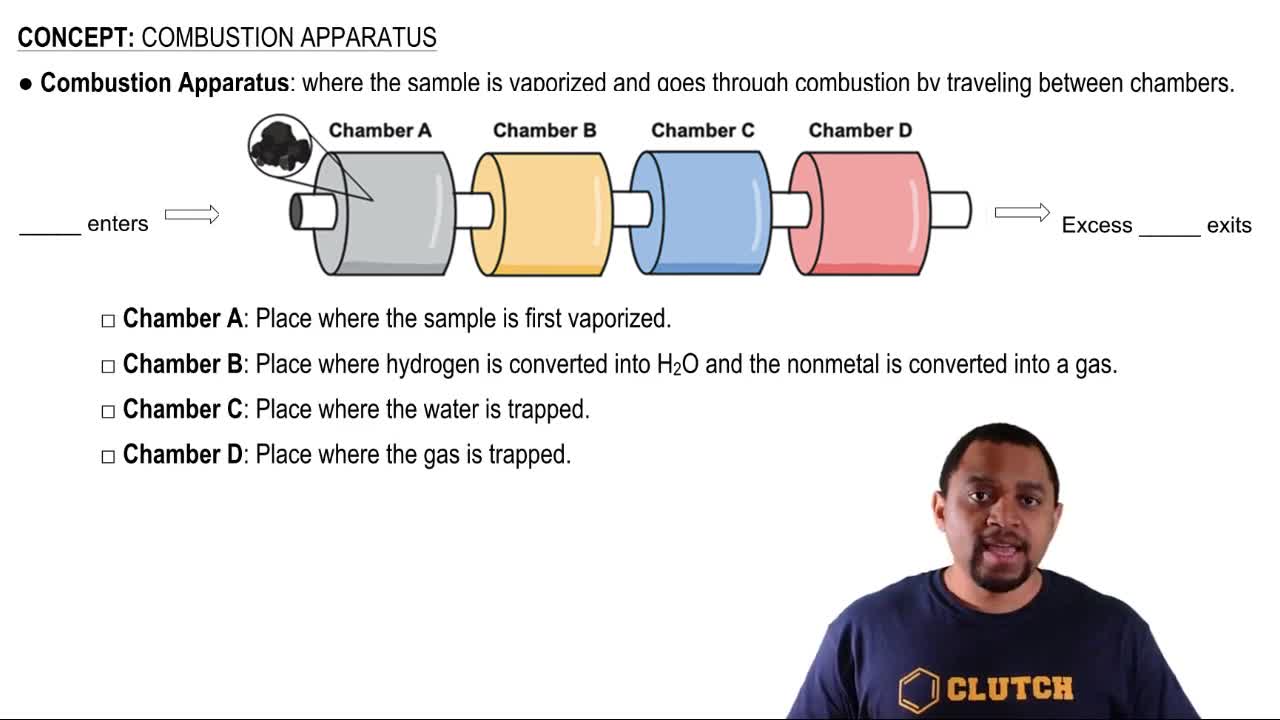
(d) When gases C and D were passed through a hot tube of powdered copper, gas C reacted to form CuO. The remaining gas, D, was collected in a third 500.0-mL flask and found to have a mass of 0.168 g and a pressure of 223 mm Hg at 25 °C. How many moles each of C and D were present, and what are their likely identities?