An electron with a mass of 9.1 * 10-28 g is traveling at 1.8 * 107 m/s in an electron microscope. Calculate the kinetic energy of electron in units of joules, and report your answer in scientific notation. (LO 1.11) (a) 1.5 * 10-16 J (b) 1.6 * 10-20 J (c) 2.9 * 10-13 J (d) 2.9 * 10-10 J
Verified step by step guidance
1
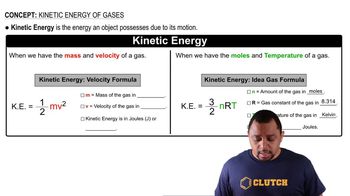
Identify the formula for kinetic energy: \( KE = \frac{1}{2}mv^2 \), where \( m \) is mass and \( v \) is velocity.
Substitute the given values into the formula: \( m = 9.1 \times 10^{-28} \) g and \( v = 1.8 \times 10^7 \) m/s.
Convert the mass from grams to kilograms by multiplying by \( 10^{-3} \) since 1 g = 0.001 kg.
Calculate \( v^2 \) by squaring the velocity: \( (1.8 \times 10^7)^2 \).
Substitute the converted mass and calculated \( v^2 \) into the kinetic energy formula and simplify to find the kinetic energy in joules.
Verified video answer for a similar problem:
This video solution was recommended by our tutors as helpful for the problem above.
Video duration:
1m
Play a video:
0 Comments
Was this helpful?
Key Concepts
Here are the essential concepts you must grasp in order to answer the question correctly.
Kinetic Energy Formula
The kinetic energy (KE) of an object can be calculated using the formula KE = 0.5 * m * v², where m is the mass and v is the velocity of the object. This formula shows that kinetic energy is directly proportional to the mass and the square of the velocity, meaning that even small increases in speed can lead to significant increases in kinetic energy.
In physics, it is essential to use consistent units when performing calculations. Mass is often measured in kilograms (kg) in the SI system, while velocity is measured in meters per second (m/s). Kinetic energy is measured in joules (J), where 1 joule is equivalent to 1 kg·m²/s². Converting units correctly is crucial for accurate results.
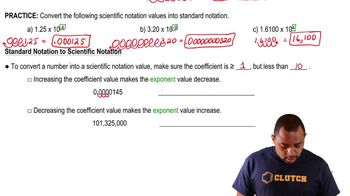
Scientific notation is a way of expressing numbers that are too large or too small to be conveniently written in decimal form. It is represented as a product of a number between 1 and 10 and a power of ten, such as 1.5 * 10^-16. This notation simplifies calculations and comparisons, especially in fields like chemistry and physics where extreme values are common.