Ch.7 - Periodic Properties of the Elements
Brown - Chemistry: The Central Science 15th Edition
Brown15th EditionChemistry: The Central ScienceISBN: 9780137542970Not the one you use?Change textbook
Chapter 7, Problem 3b

Consider the Mg2+, Cl-, K+, and Se2- ions. The four spheres below represent these four ions, scaled according to ionic size. (b) In terms of size, between which of the spheres would you find the (i) Ca2+ and (ii) S2- ions?

Verified step by step guidance
1
Identify the periodic trends: Ionic size generally increases down a group and decreases across a period.
Compare the given ions: Mg^{2+}, Cl^{-}, K^{+}, and Se^{2-}. Note that cations are generally smaller than their parent atoms, and anions are larger.
Order the given ions by size: Typically, K^{+} > Cl^{-} > Se^{2-} > Mg^{2+}.
Determine where Ca^{2+} fits: Ca^{2+} is larger than Mg^{2+} but smaller than K^{+}, so it would be between Mg^{2+} and K^{+}.
Determine where S^{2-} fits: S^{2-} is larger than Se^{2-} but smaller than Cl^{-}, so it would be between Se^{2-} and Cl^{-}.

Verified video answer for a similar problem:

This video solution was recommended by our tutors as helpful for the problem above.
Video duration:
1m

Key Concepts

Here are the essential concepts you must grasp in order to answer the question correctly.

Ionic Size

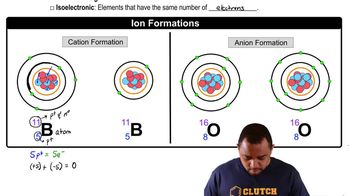
Ionic size refers to the radius of an ion in a crystal lattice or in solution. Cations, like Mg<sup>2+</sup> and Ca<sup>2+</sup>, are typically smaller than their neutral atoms due to the loss of electrons, which reduces electron-electron repulsion. Conversely, anions, such as Cl<sup>-</sup> and Se<sup>2-</sup>, are larger than their neutral atoms because the addition of electrons increases repulsion among them.
Recommended video:

Trends in Ionic Radii

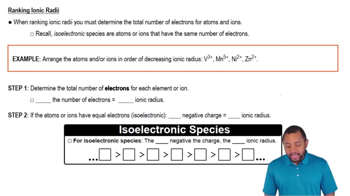
Ionic radii exhibit periodic trends in the periodic table. Generally, ionic size increases down a group due to the addition of electron shells, while it decreases across a period from left to right due to increasing nuclear charge. Understanding these trends helps predict the relative sizes of ions, such as where Ca<sup>2+</sup> and S<sup>2-</sup> would fit among the given ions.
Recommended video:
Guided course
03:56
Ranking Ionic Radii

Comparison of Ions

When comparing ions, it is essential to consider both their charge and their position in the periodic table. For example, Ca<sup>2+</sup> is a cation with a +2 charge, typically smaller than K<sup>+</sup> but larger than Mg<sup>2+</sup>. In contrast, S<sup>2-</sup> is an anion with a -2 charge, which makes it larger than Cl<sup>-</sup> and Se<sup>2-</sup>. This comparison is crucial for determining the relative positions of these ions based on size.
Recommended video:
Guided course
06:17
Ion Formation