Ch.19 - Chemical Thermodynamics
Brown - Chemistry: The Central Science 15th Edition
Brown15th EditionChemistry: The Central ScienceISBN: 9780137542970Not the one you use?Change textbook
Chapter 19, Problem 31b

Would each of the following changes increase, decrease, or have no effect on the number of microstates available to a system: (b) decrease in volume

Verified step by step guidance
1
Understand the concept of microstates: Microstates refer to the different ways in which the energy of a system can be distributed among its particles at a given energy level. The number of microstates (\(\text{W}\)) is related to the entropy (\(\text{S}\)) of the system, where higher microstates mean higher entropy.
Consider the effect of volume on microstates: When the volume of a system decreases, the particles are confined to a smaller space. This confinement limits the number of positions and orientations each particle can assume.
Relate volume decrease to particle movement: In a smaller volume, particles have less space to move around, which reduces the number of possible energy distributions among the particles.
Conclude the effect on microstates: Since the number of available positions and orientations for particles decreases with a decrease in volume, the number of microstates (\(\text{W}\)) available to the system also decreases.
Link to entropy: A decrease in the number of microstates leads to a decrease in the entropy (\(\text{S}\)) of the system, according to the formula \(\text{S}\) = k \(\text{ln}\) \(\text{W}\), where \(\text{k}\) is the Boltzmann constant.

Verified video answer for a similar problem:

This video solution was recommended by our tutors as helpful for the problem above.
Video duration:
1m

Key Concepts

Here are the essential concepts you must grasp in order to answer the question correctly.

Microstates

Microstates refer to the specific configurations or arrangements of particles in a system that correspond to a particular macroscopic state. The number of microstates is crucial in statistical mechanics, as it relates to the entropy of the system. A higher number of microstates indicates greater disorder and higher entropy, while fewer microstates suggest more order and lower entropy.
Recommended video:
Guided course
01:23
The Boltzmann Equation

Entropy

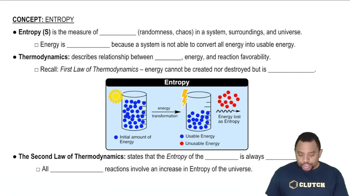
Entropy is a measure of the disorder or randomness in a system. In thermodynamics, it quantifies the number of ways a system can be arranged while maintaining the same energy level. According to the second law of thermodynamics, the entropy of an isolated system tends to increase over time, reflecting a natural tendency towards greater disorder.
Recommended video:
Guided course
02:46
Entropy in Thermodynamics

Volume and Microstates

The volume of a system directly influences the number of available microstates. When the volume decreases, the space available for particles to occupy is reduced, which typically leads to a decrease in the number of possible arrangements of those particles. Consequently, this reduction in volume generally results in a decrease in entropy, as there are fewer microstates available for the system.
Recommended video:
Guided course
02:35
Constant-Volume Calorimetry