
The enthalpy of fusion of water is 6.01 kJ/mol. Sunlight striking Earth's surface supplies 168 W per square meter (1 W = 1 watt = 1 J/s). (b) The specific heat capacity of ice is 2.032 J/g°C. If the initial temperature of a 1.00 square emter patch of ice is -5.0°C, what is its final temperature after being in sunlight for 12 h, assuming no phase changes and assuming that sunlight penetration uniformly to a depth of 1.00 cm?
Ch.18 - Chemistry of the Environment

Brown15th EditionChemistry: The Central ScienceISBN: 9780137542970Not the one you use?Change textbook
Chapter 18, Problem 36
Phosphorus is present in seawater to the extent of 0.07 ppm by mass. Assuming that the phosphorus is present as dihydrogenphosphate, H2PO4-, calculate the correspond-ing molar concentration of H2PO4- in seawater.
Verified step by step guidance1
Understand that 0.07 ppm (parts per million) means 0.07 grams of phosphorus per 1,000,000 grams of seawater.
Calculate the mass of phosphorus in 1 liter of seawater, assuming the density of seawater is approximately 1 g/mL, which means 1 liter of seawater weighs about 1000 grams.
Determine the mass of phosphorus in 1 liter of seawater using the ppm value: (0.07 grams of phosphorus / 1,000,000 grams of seawater) * 1000 grams of seawater.
Convert the mass of phosphorus to moles using the molar mass of phosphorus (approximately 30.97 g/mol).
Assume all phosphorus is present as dihydrogen phosphate (H2PO4-), and use the moles of phosphorus to find the molar concentration of H2PO4- in seawater.

Verified video answer for a similar problem:
This video solution was recommended by our tutors as helpful for the problem above.
Video duration:
4mWas this helpful?
Key Concepts
Here are the essential concepts you must grasp in order to answer the question correctly.
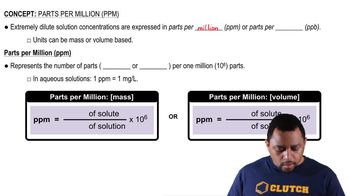
Parts Per Million (ppm)
Parts per million (ppm) is a unit of measurement used to describe the concentration of a substance in a solution. It indicates how many parts of a substance are present in one million parts of the total solution. In this context, 0.07 ppm means that there are 0.07 grams of phosphorus per one million grams of seawater, which is essential for calculating molar concentration.
Recommended video:
Guided course
Parts per Million (ppm)
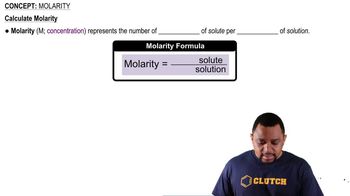
Molar Concentration
Molar concentration, or molarity, is defined as the number of moles of solute per liter of solution. It is a crucial concept in chemistry for quantifying the concentration of a substance in a solution. To find the molar concentration of H2PO4- in seawater, one must convert the mass of phosphorus from ppm to moles and then relate it to the volume of seawater.
Recommended video:
Guided course
Molarity Concept
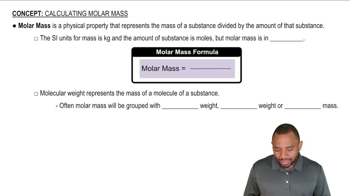
Molar Mass
Molar mass is the mass of one mole of a substance, typically expressed in grams per mole (g/mol). For dihydrogen phosphate (H2PO4-), the molar mass is calculated by summing the atomic masses of its constituent elements: hydrogen, phosphorus, and oxygen. This value is essential for converting grams of phosphorus to moles, which is necessary for determining the molar concentration in seawater.
Recommended video:
Guided course
Molar Mass Concept
Related Practice
Textbook Question
2
views
Textbook Question
What is the molarity of Na+ in a solution of NaCl whose salinity is 5.6 if the solution has a density of 1.03 g>mL?
25
views
Textbook Question
An important reaction in the formation of photochemical smog is the photodissociation of NO : NO2 + hv → NO(g) + O(g) The maximum wavelength of light that can cause this reac- tion is 420 nm. (a) In what part of the electromagnetic spec- trum is light with this wavelength found?
2
views
Textbook Question
The enthalpy of evaporation of water is 40.67 kJ/mol. Sunlight striking Earth's surface supplies 168 W per square meter (1 W = 1 watt = 1 J/s). (a) Assuming that evaporation of water is due only to energy input from the Sun, calculate how many grams of water could be evaporated from a 1.00 square meter patch of ocean over a 12-h day
1
views
