
Ortho-Dichlorobenzene, C6H4Cl2, is obtained when two of the adjacent hydrogen atoms in benzene are replaced with Cl atoms. A skeleton of the molecule is shown here. (b) Are there any resonance structures for the molecule? If so, sketch them.
Ch.8 - Basic Concepts of Chemical Bonding

Brown15th EditionChemistry: The Central ScienceISBN: 9780137542970Not the one you use?Change textbook
Chapter 8, Problem 99d
Two compounds are isomers if they have the same chemical formula but different arrangements of atoms. Use Table 8.3 to estimate H for each of the following gas-phase isomerization reactions and indicate which isomer has the lower enthalpy. (d) Methyl isocyanide → Acetonitrile
Verified step by step guidance1
Identify the chemical formulas for methyl isocyanide and acetonitrile. Both compounds have the formula C2H3N.
Use Table 8.3 to find the standard enthalpy of formation (\( \Delta H_f^\circ \)) for each compound: methyl isocyanide and acetonitrile.
Calculate the enthalpy change (\( \Delta H \)) for the isomerization reaction using the formula: \( \Delta H = \Delta H_f^\circ (\text{products}) - \Delta H_f^\circ (\text{reactants}) \).
Substitute the \( \Delta H_f^\circ \) values from Table 8.3 into the equation to find \( \Delta H \) for the reaction: Methyl isocyanide → Acetonitrile.
Determine which isomer has the lower enthalpy by comparing the \( \Delta H_f^\circ \) values of methyl isocyanide and acetonitrile. The isomer with the lower \( \Delta H_f^\circ \) value is more stable.

Verified video answer for a similar problem:
This video solution was recommended by our tutors as helpful for the problem above.
Video duration:
2mWas this helpful?
Key Concepts
Here are the essential concepts you must grasp in order to answer the question correctly.
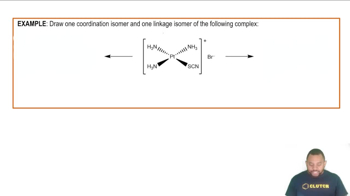
Isomerism
Isomerism refers to the phenomenon where two or more compounds share the same molecular formula but differ in the arrangement of atoms. This can lead to distinct physical and chemical properties, making isomers an important concept in organic chemistry. Isomers can be classified into structural isomers, which differ in connectivity, and stereoisomers, which differ in spatial arrangement.
Recommended video:
Guided course
Isomerism in Coordination Complexes Example
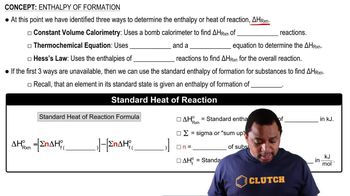
Enthalpy Change (ΔH)
Enthalpy change (ΔH) is a measure of the heat content of a system at constant pressure. It indicates whether a reaction is exothermic (releases heat, ΔH < 0) or endothermic (absorbs heat, ΔH > 0). In the context of isomerization reactions, comparing the enthalpy changes helps determine which isomer is more stable, as lower enthalpy corresponds to greater stability.
Recommended video:
Guided course
Enthalpy of Formation
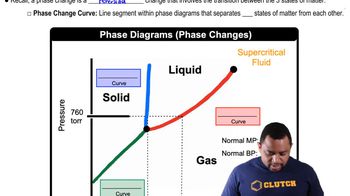
Gas-Phase Reactions
Gas-phase reactions occur when reactants and products are in the gaseous state, allowing for different kinetic and thermodynamic behaviors compared to reactions in solution or solid states. In gas-phase isomerization, factors such as molecular interactions and energy barriers play a crucial role in determining the reaction pathway and the stability of the resulting isomers.
Recommended video:
Guided course
Phase Changes in Diagrams
Related Practice
Textbook Question
Textbook Question
Ortho-Dichlorobenzene, C6H4Cl2, is obtained when two of the adjacent hydrogen atoms in benzene are replaced with Cl atoms. A skeleton of the molecule is shown here. (a) Complete a Lewis structure for the molecule using bonds and electron pairs as needed.
Textbook Question
The electron affinity of oxygen is -141 kJ/mol, corresponding to the reaction O(g) + e- → O-(g). The lattice energy of K2O(s) is 2238 kJ/mol. Use these data along with data in Appendix C and Figure 7.11 to calculate the 'second electron affinity' of oxygen, corresponding to the reaction O-(g) + e- → O2-(g)
Textbook Question
a. Triazine, C3H3N3, is like benzene except that in triazine every other C—H group is replaced by a nitrogen atom. Draw the Lewis structure(s) for the triazine molecule.
