Using Lewis symbols and Lewis structures, diagram the formation of SiCl4 from Si and Cl atoms, showing valence-shell electrons. e. How many bonding pairs of electrons are in the SiCl4 molecule?

Ch.8 - Basic Concepts of Chemical Bonding

Brown15th EditionChemistry: The Central ScienceISBN: 9780137542970Not the one you use?Change textbook
Chapter 8, Problem 33b
(b) A substance, XY, formed from two different elements, melts at −33 °C. Is XY likely to be a covalent or an ionic substance?
Verified step by step guidance1
insert step 1> Identify the characteristics of covalent and ionic substances.
insert step 2> Consider the melting point of the substance XY, which is -33 °C.
insert step 3> Compare the melting point of XY with typical melting points of covalent and ionic substances.
insert step 4> Recall that ionic compounds generally have high melting points due to strong electrostatic forces between ions.
insert step 5> Conclude that a low melting point, like -33 °C, suggests that XY is likely a covalent substance, as covalent compounds typically have lower melting points.

Verified video answer for a similar problem:
This video solution was recommended by our tutors as helpful for the problem above.
Video duration:
1mWas this helpful?
Key Concepts
Here are the essential concepts you must grasp in order to answer the question correctly.
Covalent vs. Ionic Bonds
Covalent bonds form when two nonmetals share electrons, resulting in molecules with lower melting and boiling points. In contrast, ionic bonds occur between metals and nonmetals, where electrons are transferred, creating charged ions that attract each other, typically resulting in higher melting points.
Recommended video:
Guided course
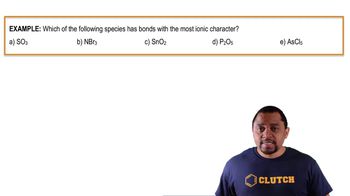
Chemical Bonds Example 1
Melting Point as an Indicator
The melting point of a substance can provide insight into its bonding type. Generally, substances with ionic bonds have higher melting points due to the strong electrostatic forces between ions, while covalent compounds often have lower melting points due to weaker intermolecular forces.
Recommended video:
Guided course
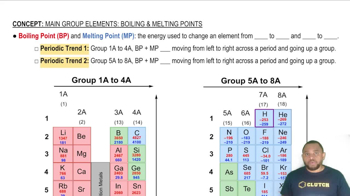
Boiling Point and Melting Point
Properties of Molecular Compounds
Molecular compounds, which are often formed by covalent bonds, tend to have distinct properties such as lower melting points, volatility, and poor electrical conductivity in solid form. The melting point of −33 °C suggests that XY is likely a molecular compound, indicating it is more likely to be covalent.
Recommended video:
Guided course
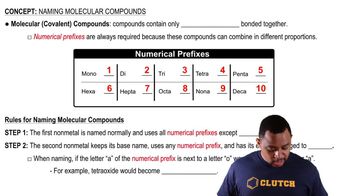
Naming Molecular Compounds
Related Practice
Textbook Question
Textbook Question
(a) Based on the lattice energies of MgCl2 and SrCl2 given in Table 8.1, what is the range of values that you would expect for the lattice energy of CaCl2?
Textbook Question
Using Lewis symbols and Lewis structures, diagram the formation of PF3 from P and F atoms, showing valence-shell electrons. (a) How many valence electrons does P have initially? (c) How many valence electrons surround the P in the PF3 molecule? (d) How many valence electrons surround each P in the PF3 molecule?
Textbook Question
Use data from Appendix C, Figure 7.11, and Figure 7.13 to calculate the lattice energy of KI.
Textbook Question
(b) Using data from Appendix C, Figure 7.11, Figure 7.13, and the value of the second ionization energy for Ca, 1145 kJ/mol, calculate the lattice energy of CaCl2.