Predict whether each of the following oxides is ionic or molecular: SnO2, Al2O3, CO2, Li2O, Fe2O3, H2O.
Ch.7 - Periodic Properties of the Elements

Brown15th EditionChemistry: The Central ScienceISBN: 9780137542970Not the one you use?Change textbook
Chapter 7, Problem 56
You read the following statement about two elements X and Y: One of the elements is a good conductor of electricity, and the other is a semiconductor. Experiments show that the first ionization energy of X is twice as great as that of Y. Which element has the greater metallic character?
Verified step by step guidance1
Identify the properties of metals and semiconductors: Metals are typically good conductors of electricity, while semiconductors have intermediate conductivity that can be modified under certain conditions.
Understand the relationship between ionization energy and metallic character: Elements with lower ionization energies tend to lose electrons more easily, which is a characteristic of metals. Therefore, an element with a lower ionization energy is likely to have greater metallic character.
Analyze the given information: Element X has a first ionization energy that is twice as great as that of element Y. This means that element X requires more energy to remove an electron compared to element Y.
Determine the metallic character based on ionization energy: Since element Y has a lower ionization energy, it is more likely to lose electrons easily, indicating that it has a greater metallic character compared to element X.
Conclude which element has the greater metallic character: Based on the analysis, element Y, with the lower ionization energy, has the greater metallic character.
Key Concepts
Here are the essential concepts you must grasp in order to answer the question correctly.
Metallic Character
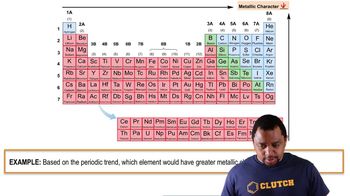
Metallic character refers to the tendency of an element to lose electrons and form positive ions, which is a characteristic of metals. Elements with high metallic character are typically good conductors of heat and electricity, have high malleability and ductility, and tend to have lower ionization energies. As you move down a group in the periodic table, metallic character increases, while it decreases across a period from left to right.
Recommended video:
Guided course
Metallic Character Example
Ionization Energy
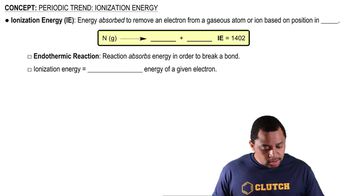
Ionization energy is the energy required to remove an electron from an atom in its gaseous state. It is a key factor in determining an element's reactivity and metallic character. Generally, elements with lower ionization energies are more metallic, as they can more easily lose electrons. The statement indicates that element X has a higher ionization energy than element Y, suggesting that Y may have greater metallic character.
Recommended video:
Guided course
Ionization Energy
Conductivity and Semiconductors
Conductivity refers to the ability of a material to conduct electricity, which is a property of metals and some non-metals known as semiconductors. Metals are excellent conductors due to their free-moving electrons, while semiconductors have intermediate conductivity that can be altered by temperature or impurities. The distinction between a good conductor and a semiconductor is crucial in determining the properties of elements X and Y in the context of their metallic character.
Recommended video:
Guided course
Extensive Property Example
Related Practice
Textbook Question
1
views
Textbook Question
True or false: Because elements that form cations are metals, and elements that form anions are nonmetals, elements that do not form ions are metalloids.
Textbook Question
Consider the following equation:
Ca+(𝑔)+e−⟶Ca(𝑔)
Which of the following statements are true?
i. The energy change for this process is the electron affinity of the Ca+ ion.
ii. The energy change for this process is the negative of the first ionization energy of the Ca atom.
iii. The energy change for this process is the negative of the electron affinity of the Ca atom.
a. Only statement i is true.
b. Only statement ii is true.
c. Only statement iii is true.
d. Only statements i and ii are true.
e. All three statements are true.