Which of the following chemical equations is connected to the definitions of (a) the first ionization energy of oxygen (i) O1g2 + e-¡O-1g2 (ii) O1g2¡O+1g2 + e- (iii) O1g2 + 2 e-¡O2-1g2 (iv) O1g2¡O2+1g2 + 2 e- (v) O+1g2¡O2+1g2 + e-

Ch.7 - Periodic Properties of the Elements

Brown15th EditionChemistry: The Central ScienceISBN: 9780137542970Not the one you use?Change textbook
Chapter 7, Problem 94b
Identify two ions that have the following ground-state electron configurations: (b) [Ar]3d5
Verified step by step guidance1
Identify the neutral atom with the given electron configuration.
Recognize that the configuration [Ar]3d^5 corresponds to the element Manganese (Mn) in its neutral state.
Determine the possible ions by adding or removing electrons from the neutral atom.
Consider the removal of electrons to form a cation: Mn^2+ is a common ion, which would have the configuration [Ar]3d^5 after losing two 4s electrons.
Consider the addition of electrons to form an anion: Technically, Mn does not commonly form anions, but if it did, adding electrons would fill the 3d orbitals further.

Verified video answer for a similar problem:
This video solution was recommended by our tutors as helpful for the problem above.
Video duration:
3mWas this helpful?
Key Concepts
Here are the essential concepts you must grasp in order to answer the question correctly.
Electron Configuration
Electron configuration describes the distribution of electrons in an atom's orbitals. It is represented using a notation that indicates the energy levels and sublevels occupied by electrons. For example, [Ar]3d5 indicates that the electron configuration follows the argon core, with five electrons in the 3d subshell, which is crucial for identifying specific ions.
Recommended video:
Guided course
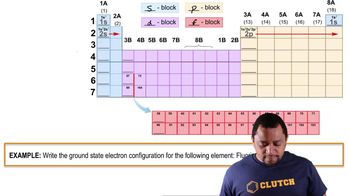
Electron Configuration Example
Ionic Charge
Ionic charge refers to the electrical charge that an atom or molecule acquires when it loses or gains electrons. Cations are positively charged ions formed by losing electrons, while anions are negatively charged ions formed by gaining electrons. Understanding the ionic charge is essential for determining which ions correspond to a given electron configuration.
Recommended video:
Guided course
Formal Charge
Transition Metals
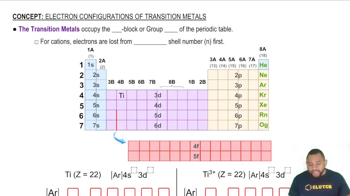
Transition metals are elements found in the d-block of the periodic table, characterized by their ability to form variable oxidation states and colored compounds. The electron configuration [Ar]3d5 corresponds to a half-filled d subshell, which is a stable configuration often seen in transition metal ions like Mn2+ and Cr3+. Recognizing these elements helps in identifying the ions with the specified electron configuration.
Recommended video:
Guided course
Transition Metals
Related Practice
Textbook Question
Textbook Question
(a) Use orbital diagrams to illustrate what happens when an oxygen atom gains two electrons
Textbook Question
Hydrogen is an unusual element because it behaves in some ways like the alkali metal elements and in other ways like nonmetals. Its properties can be explained in part by its electron configuration and by the values for its ionization energy and electron affinity. (a) Explain why the electron affinity of hydrogen is much closer to the values for the alkali elements than for the halogens.
Textbook Question
Identify two ions that have the following ground-state electron configurations: (c) [Kr]5s24d10
Textbook Question
Identify two ions that have the following ground-state electron configurations: (a) [Ar]