Write equations that show the process for a. the first two ionization energies of lead and b. the fourth ionization energy of zirconium.

Ch.7 - Periodic Properties of the Elements

Brown15th EditionChemistry: The Central ScienceISBN: 9780137542970Not the one you use?Change textbook
Chapter 7, Problem 43
Write equations that show the processes that describe the first, second, and third ionization energies of an aluminum atom. Which process would require the least amount of energy?
Verified step by step guidance1
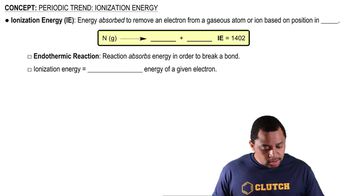
Step 1: Understand the concept of ionization energy. Ionization energy is the energy required to remove an electron from an atom in the gaseous state.
Step 2: Write the equation for the first ionization energy of aluminum. This involves removing the first electron from a neutral aluminum atom: \[ \text{Al(g)} \rightarrow \text{Al}^+(g) + e^- \]
Step 3: Write the equation for the second ionization energy of aluminum. This involves removing a second electron from the singly charged aluminum ion: \[ \text{Al}^+(g) \rightarrow \text{Al}^{2+}(g) + e^- \]
Step 4: Write the equation for the third ionization energy of aluminum. This involves removing a third electron from the doubly charged aluminum ion: \[ \text{Al}^{2+}(g) \rightarrow \text{Al}^{3+}(g) + e^- \]
Step 5: Determine which process requires the least amount of energy. The first ionization energy generally requires the least energy because it involves removing an electron from a neutral atom, which is less energetically demanding than removing electrons from positively charged ions.

Verified video answer for a similar problem:
This video solution was recommended by our tutors as helpful for the problem above.
Video duration:
4mWas this helpful?
Key Concepts
Here are the essential concepts you must grasp in order to answer the question correctly.
Ionization Energy
Ionization energy is the energy required to remove an electron from a gaseous atom or ion. It is a measure of how strongly an atom holds onto its electrons. The first ionization energy refers to the removal of the first electron, while subsequent ionization energies involve removing additional electrons from the resulting cations. Generally, ionization energy increases with each successive electron removed due to the increasing positive charge of the ion.
Recommended video:
Guided course
Ionization Energy
Aluminum's Electron Configuration
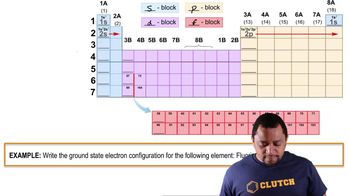
Aluminum has an atomic number of 13, with an electron configuration of [Ne] 3s² 3p¹. This configuration indicates that aluminum has three valence electrons in its outer shell. Understanding the electron configuration is crucial for predicting the ionization processes, as the first ionization energy will involve removing the 3p electron, while the second and third will involve removing the 3s electrons, which are held more tightly due to increased nuclear charge.
Recommended video:
Guided course
Electron Configuration Example
Trends in Ionization Energy
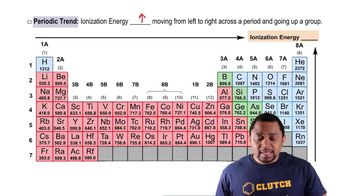
Ionization energy trends can be observed across periods and groups in the periodic table. Generally, ionization energy increases across a period due to increasing nuclear charge and decreases down a group due to increased distance from the nucleus and electron shielding. For aluminum, the first ionization energy will be the lowest because it involves removing the least tightly held electron, while the second and third ionization energies will require progressively more energy due to the increased positive charge of the ion.
Recommended video:
Guided course
Ionization Energy Trends
Related Practice
Textbook Question
Textbook Question
a. Write an equation for the second electron affinity of chlorine.
b. Would you predict a positive or a negative quantity for this process?
Textbook Question
rue or false: If the electron affinity for an element is a negative number, then the anion of the element is more stable than the neutral atom.
Textbook Question
Based on their positions in the periodic table, predict which atom of the following pairs will have the smaller first ionization energy: (a) Br, Kr (b) C, Ca (c) Li, Rb (d) S, Ge (e) Al, B.
Textbook Question
Which of the ions Ni2+, Fe2+, Co3+, and Pt2+ has an electron configuration of 𝑛𝑑6(𝑛=3,4,5,…)?
a. Ni2+
b. Fe2+
c. Co3+
d. Pt2+
e. More than one of these
Textbook Question
Which element has the highest second ionization energy: Li, K, or Be?