
Textbook Question
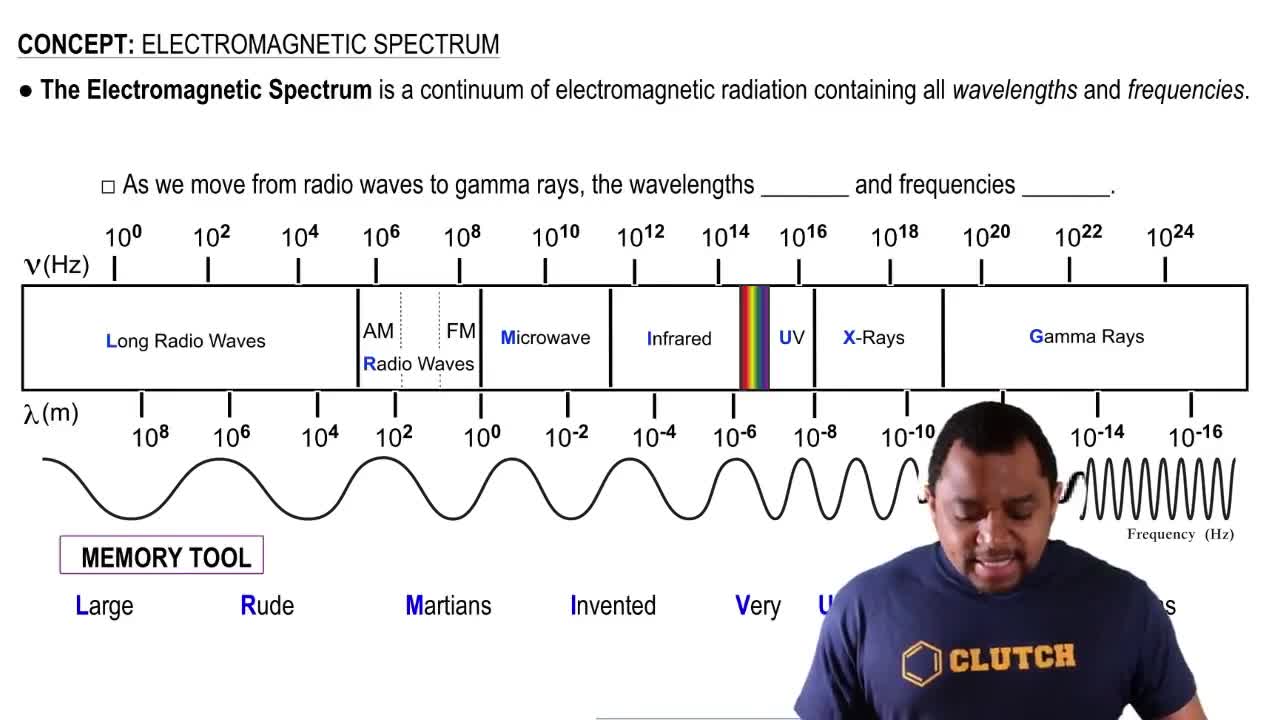
One of the emission lines of the hydrogen atom has a wavelength of 93.07 nm. b. Determine the initial and final values of n associated with this emission.

 Verified step by step guidance
 02:53
02:53
 00:31
00:31 02:52
02:52One of the emission lines of the hydrogen atom has a wavelength of 93.07 nm. b. Determine the initial and final values of n associated with this emission.
The Lyman series of emission lines of the hydrogen atom are those for which nf = 1. (a) Determine the region of the electromagnetic spectrum in which the lines of the Lyman series are observed.
The visible emission lines observed by Balmer all involved nf = 2. (b) Calculate the wavelengths of the first three lines in the Balmer series—those for which ni = 3, 4, and 5—and identify these lines in the emission spectrum shown in Figure 6.11.
Order the following transitions in the hydrogen atom from smallest to largest frequency of light absorbed: n = 3 to n = 6, n = 4 to n = 9, n = 2 to n = 3, and n = 1 to n = 2.
The Lyman series of emission lines of the hydrogen atom are those for which nf = 1. (b) Calculate the wavelengths of the first three lines in the Lyman series—those for which ni = 2, 3, and 4.
The hydrogen atom can absorb light of wavelength 1094 nm. (b) Determine the final value of n associated with this absorption.