

Label each of the following statements as true or false. a. The frequency of radiation increases as the wavelength increases. b. Electromagnetic radiation travels through a vacuum at a constant speed, regardless of wavelength. c. Infrared light has higher frequencies than visible light. d. The glow from a fireplace, the energy within a microwave oven, and a foghorn blast are all forms of electromagnetic radiation.
Ch.6 - Electronic Structure of Atoms

Brown15th EditionChemistry: The Central ScienceISBN: 9780137542970Not the one you use?Change textbook
Chapter 6, Problem 18
List the following types of electromagnetic radiation in order of increasing wavelength: (a) the gamma rays produced by a radioactive nuclide used in medical imaging; (b) radiation from an FM radio station at 93.1 MHz on the dial; (c) a radio signal from an AM radio station at 680 kHz on the dial; (d) the yellow light from sodium vapor streetlights; (e) the red light of a light-emitting diode, such as in a calculator display.
Verified step by step guidance1
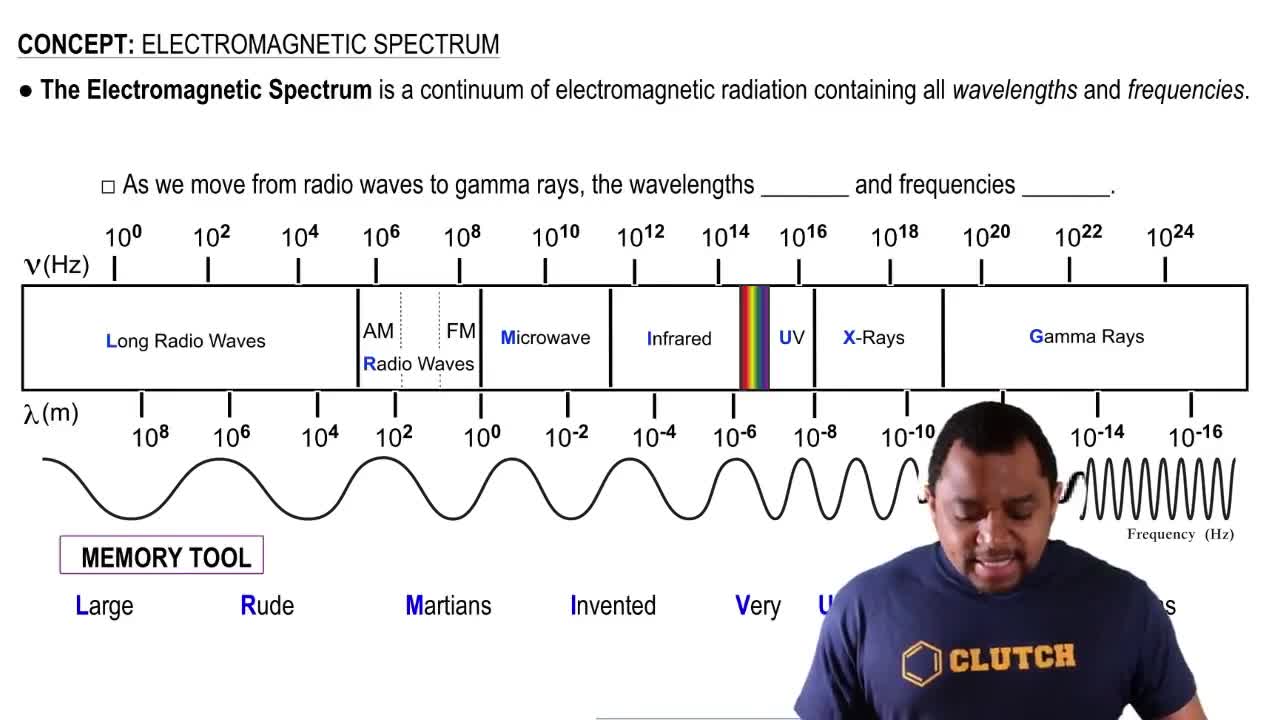
Step 1: Understand that electromagnetic radiation can be ordered by wavelength, frequency, or energy. Wavelength and frequency are inversely related, meaning as wavelength increases, frequency decreases.
Step 2: Identify the given types of electromagnetic radiation and their typical wavelength ranges: (a) Gamma rays have very short wavelengths, (b) FM radio waves have longer wavelengths than gamma rays, (c) AM radio waves have even longer wavelengths than FM radio waves, (d) Yellow light has a wavelength in the visible spectrum, shorter than radio waves but longer than gamma rays, (e) Red light also falls in the visible spectrum, with a longer wavelength than yellow light.
Step 3: Convert the frequencies of the radio waves to wavelengths using the formula \( \lambda = \frac{c}{f} \), where \( \lambda \) is the wavelength, \( c \) is the speed of light (approximately \( 3.00 \times 10^8 \) m/s), and \( f \) is the frequency.
Step 4: Compare the calculated wavelengths of the FM and AM radio waves with the known ranges of gamma rays, yellow light, and red light to establish the order of increasing wavelength.
Step 5: List the types of radiation in order of increasing wavelength based on your comparisons: gamma rays, yellow light, red light, FM radio waves, AM radio waves.
Key Concepts
Here are the essential concepts you must grasp in order to answer the question correctly.
Electromagnetic Spectrum
The electromagnetic spectrum encompasses all types of electromagnetic radiation, arranged by wavelength or frequency. It ranges from gamma rays, which have very short wavelengths, to radio waves, which have much longer wavelengths. Understanding the spectrum is crucial for comparing different types of radiation and their properties.
Recommended video:
Guided course
Electromagnetic Spectrum
Wavelength and Frequency Relationship
Wavelength and frequency are inversely related properties of electromagnetic radiation. As the wavelength increases, the frequency decreases, and vice versa. This relationship is described by the equation c = λν, where c is the speed of light, λ is the wavelength, and ν is the frequency, allowing for the calculation of one property if the other is known.
Recommended video:
Guided course
Frequency-Wavelength Relationship
Types of Electromagnetic Radiation
Different types of electromagnetic radiation include gamma rays, X-rays, ultraviolet light, visible light, infrared radiation, microwaves, and radio waves. Each type has distinct applications and characteristics, such as energy levels and interactions with matter. Recognizing these types helps in categorizing and ordering them based on their wavelengths.
Recommended video:
Guided course
Electromagnetic Radiation Example
Related Practice
Textbook Question
Textbook Question
Arrange the following kinds of electromagnetic radiation in order of increasing wavelength: infrared light, green light, red light, radio waves, X rays, ultraviolet light.
Textbook Question
A laser pointer used in a lecture hall emits light at 650 nm. What is the frequency of this radiation?
Textbook Question
(d) What distance does electromagnetic radiation travel in 0.38 ps?
Textbook Question
(a) What is the frequency of radiation that has a wavelength of 10 µm, about the size of a bacterium?
1
views
Textbook Question
Label each of the following statements as true or false. c. X rays travel faster than microwaves.
