
Textbook Question
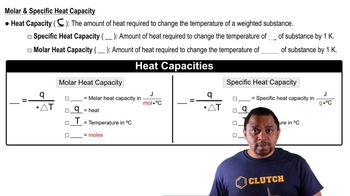
b. What are the units of specific heat?

 Verified step by step guidance
 02:19
02:19 02:19 02:19
b. What are the units of specific heat?
(d) How many kJ of heat are needed to raise the temperature of 10.00 kg of liquid water from 24.6 to 46.2 °C?
Two solid objects, A and B, are placed in boiling water and allowed to come to the temperature of the water. Each is then lifted out and placed in separate beakers containing 1000 g of water at 10.0 °C. Object A increases the water temperature by 3.50 °C; B increases the water temperature by 2.60 °C. (a) Which object has the larger heat capacity?
(b) Calculate the energy needed for this temperature change.
Consider the decomposition of liquid benzene, C6H6(l), to gaseous acetylene, C2H2(g): C6H6(l) → 3 C2H2(g) ΔH = +630 kJ (d) If C6H6(g) were consumed instead of C6H6(l), would you expect the magnitude of ΔH to increase, decrease, or stay the same? Explain.
The specific heat of ethanol, C2H5OH(l), is 2.44 J•g/K. (a) How many J of heat are needed to raise the temperature of 80.0 g of octane from 10.0 to 25.0 °C?