Determine the oxidation number for the indicated element in each of the following substances: a. S in SO2

Ch.4 - Reactions in Aqueous Solution

Brown15th EditionChemistry: The Central ScienceISBN: 9780137542970Not the one you use?Change textbook
Chapter 4, Problem 48d
Determine the oxidation number of sulfur in each of the following substances: (d) hydrogen sulfide, H2S
Verified step by step guidance1
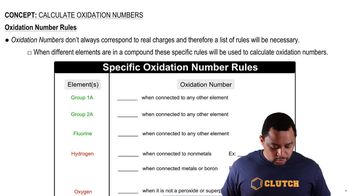
Identify the oxidation number of hydrogen (H), which is typically +1.
Let the oxidation number of sulfur (S) be x.
Write the equation for the sum of oxidation numbers in the compound: 2(+1) + x = 0, since the compound is neutral.
Simplify the equation: 2 + x = 0.
Solve for x to find the oxidation number of sulfur.

Verified video answer for a similar problem:
This video solution was recommended by our tutors as helpful for the problem above.
Video duration:
1mWas this helpful?
Key Concepts
Here are the essential concepts you must grasp in order to answer the question correctly.
Oxidation Number
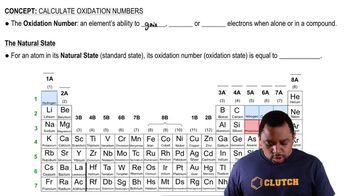
The oxidation number, or oxidation state, is a theoretical charge assigned to an atom in a compound based on the assumption that electrons are completely transferred. It helps in understanding the electron distribution in molecules and is crucial for identifying redox reactions. Oxidation numbers can be positive, negative, or zero, depending on the atom's electron gain or loss.
Recommended video:
Guided course
Oxidation Numbers
Rules for Assigning Oxidation Numbers
There are specific rules for assigning oxidation numbers, such as the fact that the oxidation number of an element in its standard state is zero, and for monoatomic ions, it equals the charge of the ion. In compounds, hydrogen typically has an oxidation number of +1, while oxygen usually has -2. These rules guide the determination of oxidation states in various compounds.
Recommended video:
Guided course
Oxidation Number Rules
Hydrogen Sulfide (H2S)
Hydrogen sulfide (H2S) is a simple binary compound consisting of hydrogen and sulfur. In H2S, each hydrogen atom has an oxidation number of +1, leading to a total of +2 from the two hydrogens. To balance this, the sulfur must have an oxidation number of -2, making it essential to apply the rules of oxidation states to determine sulfur's charge in this compound.
Recommended video:
Guided course
Hydrogenation Reactions
Related Practice
Textbook Question
Textbook Question
(a) Which region of the periodic table shown here contains elements that are easiest to oxidize? (b) Which region contains the least readily oxidized elements?
Textbook Question
True or false: a. If a substance is oxidized, it is gaining electrons.
Textbook Question
Determine the oxidation number of sulfur in each of the following substances: (a) barium sulfate, BaSO4 (b) sulfurous acid, H2SO3 (c) strontium sulfide, SrS
Textbook Question
Determine the oxidation number of sulfur in each of the following substances: (f) Which region(s) of the periodic table contains elements that can adopt both positive and negative oxidation numbers?
Textbook Question
Determine the oxidation number of sulfur in each of the following substances: (e) Locate sulfur in the periodic table in Exercise 4.47; what region is it in?
2
views