
A solid sample of Zn(OH)2 is added to 0.350 L of 0.500 M aqueous HBr. The solution that remains is still acidic. It is then titrated with 0.500 M NaOH solution, and it takes 88.5 mL of the NaOH solution to reach the equivalence point. What mass of Zn(OH)2 was added to the HBr solution?
Ch.4 - Reactions in Aqueous Solution

Brown15th EditionChemistry: The Central ScienceISBN: 9780137542970Not the one you use?Change textbook
Chapter 4, Problem 103a
(a) By titration, 15.0 mL of 0.1008 M sodium hydroxide is needed to neutralize a 0.2053-g sample of a weak acid. What is the molar mass of the acid if it is monoprotic?
Verified step by step guidance1
Step 1: Write the balanced chemical equation for the neutralization reaction. For a monoprotic acid (HA) reacting with sodium hydroxide (NaOH), the equation is: HA + NaOH -> NaA + H2O.
Step 2: Calculate the moles of NaOH used in the titration. Use the formula: \( \text{moles of NaOH} = \text{volume (L)} \times \text{molarity (M)} \). Convert 15.0 mL to liters by dividing by 1000.
Step 3: Since the acid is monoprotic, the moles of acid (HA) will be equal to the moles of NaOH used, as the reaction is a 1:1 ratio.
Step 4: Calculate the molar mass of the acid. Use the formula: \( \text{molar mass} = \frac{\text{mass of acid (g)}}{\text{moles of acid}} \).
Step 5: Substitute the known values (mass of acid and moles of acid) into the molar mass formula to find the molar mass of the acid.

Verified video answer for a similar problem:
This video solution was recommended by our tutors as helpful for the problem above.
Video duration:
2mWas this helpful?
Key Concepts
Here are the essential concepts you must grasp in order to answer the question correctly.
Titration
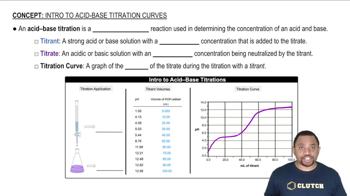
Titration is a quantitative analytical technique used to determine the concentration of a solute in a solution. In this process, a solution of known concentration (the titrant) is gradually added to a solution of unknown concentration until the reaction reaches its endpoint, which is often indicated by a color change. This method is commonly used in acid-base reactions to find the amount of acid or base present in a sample.
Recommended video:
Guided course
Acid-Base Titration
Molar Mass
Molar mass is the mass of one mole of a substance, typically expressed in grams per mole (g/mol). It is calculated by summing the atomic masses of all the atoms in a molecule. In the context of the question, determining the molar mass of the weak acid involves using the amount of acid neutralized by the known volume and concentration of sodium hydroxide during the titration.
Recommended video:
Guided course
Molar Mass Concept
Monoprotic Acid
A monoprotic acid is an acid that can donate only one proton (H⁺ ion) per molecule during a reaction. This characteristic simplifies the stoichiometry of acid-base reactions, as the number of moles of the acid will equal the number of moles of base at the equivalence point. In this case, knowing that the acid is monoprotic allows for straightforward calculations to find its molar mass based on the titration data.
Recommended video:
Guided course
Binary Acids
Related Practice
Textbook Question
Textbook Question
(b) An elemental analysis of the acid indicates that it is composed of 5.89% H, 70.6% C, and 23.5% O by mass. What is its molecular formula?
Textbook Question
Suppose you have 5.00 g of powdered magnesium metal, 1.00 L of 2.00 M potassium nitrate solution, and 1.00 L of 2.00 M silver nitrate solution. d. What is the molarity of the Mg2+ ions in the resulting solution?
Textbook Question
If 23.9 mL of the strontium hydroxide solution was needed to neutralize a 37.5 mL aliquot of the nitric acid solution, what is the concentration (molarity) of the acid?
Textbook Question
Suppose you have 5.00 g of powdered magnesium metal, 1.00 L of 2.00 M potassium nitrate solution, and 1.00 L of 2.00 M silver nitrate solution. a. Which one of the solutions will react with the magnesium powder?
