
If an Avogadro’s number of pennies is divided equally among the 321 million men, women, and children in the United States, how many dollars would each receive? How does this compare with the gross domestic product (GDP) of the United States, which was \$21.4 trillion in 2019? (GDP is the total market value of the nation’s goods and services.)
Ch.3 - Chemical Reactions and Reaction Stoichiometry

Brown15th EditionChemistry: The Central ScienceISBN: 9780137542970Not the one you use?Change textbook
Chapter 3, Problem 32
Without doing any detailed calculations (but using a periodic table to give atomic weights), rank the following samples in order of increasing numbers of atoms: 42 g of NaHCO3,1.5molCO2,6.0×1024 Ne atoms.
Verified step by step guidance1
Identify the number of atoms in each sample: NaHCO3, CO2, and Ne.
For NaHCO3, calculate the molar mass using the atomic weights from the periodic table: Na (22.99 g/mol), H (1.01 g/mol), C (12.01 g/mol), O (16.00 g/mol).
Determine the number of moles of NaHCO3 by dividing the given mass (42 g) by its molar mass.
Calculate the total number of atoms in NaHCO3 by multiplying the number of moles by Avogadro's number (6.022 x 10^23 atoms/mol) and the number of atoms per formula unit (6 atoms: 1 Na, 1 H, 1 C, 3 O).
Compare the number of atoms in each sample: 42 g of NaHCO3, 1.5 mol of CO2 (3 atoms per molecule), and 6.0 x 10^24 Ne atoms, and rank them in order of increasing number of atoms.

Verified video answer for a similar problem:
This video solution was recommended by our tutors as helpful for the problem above.
Video duration:
2mWas this helpful?
Key Concepts
Here are the essential concepts you must grasp in order to answer the question correctly.
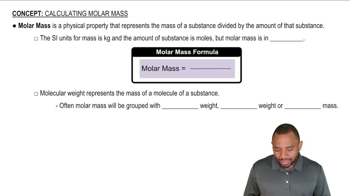
Molar Mass
Molar mass is the mass of one mole of a substance, typically expressed in grams per mole (g/mol). It is calculated by summing the atomic weights of all the atoms in a molecule. For example, sodium bicarbonate (NaHCO3) has a molar mass of approximately 84 g/mol, which is essential for determining the number of moles in a given mass.
Recommended video:
Guided course
Molar Mass Concept
Avogadro's Number
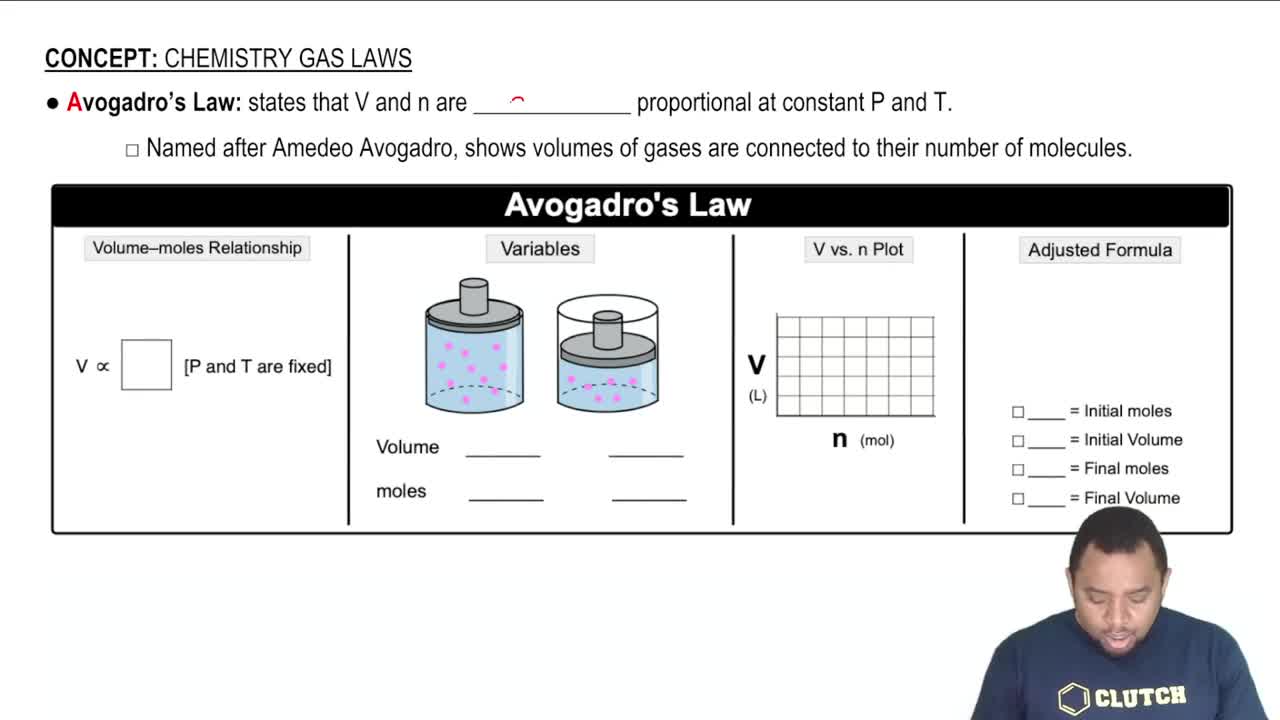
Avogadro's number, approximately 6.022 x 10^23, is the number of atoms, ions, or molecules in one mole of a substance. This constant allows chemists to convert between moles and the number of individual particles. For instance, knowing the number of moles of CO2 can help determine the total number of CO2 molecules present in a sample.
Recommended video:
Guided course
Avogadro's Law
Stoichiometry
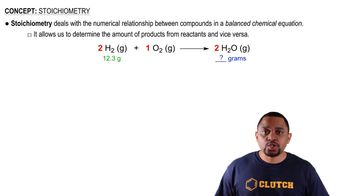
Stoichiometry is the calculation of reactants and products in chemical reactions based on the conservation of mass. It involves using molar ratios derived from balanced chemical equations to relate quantities of different substances. In this context, stoichiometry helps compare the number of atoms in different samples by converting masses or moles into a common unit.
Recommended video:
Guided course
Stoichiometry Concept
Related Practice
Textbook Question
Textbook Question
What is the mass, in kilograms, of an Avogadro's number of people, if the average mass of a person is 160 lb? How does this compare with the mass of Earth, 5.98⨉1024 kg?
1
views
Textbook Question
(b) How many bromine atoms are present in one mole of 12C?
1
views
Textbook Question
Without doing any detailed calculations (but using a periodic table to give atomic weights), rank the following samples in order of increasing numbers of atoms: 0.50 mol H2O, 23 g Na, 6.0⨉1023 N2 molecules.
1
views
Textbook Question
(a) What is the mass, in grams, of one mole of 12C?
1
views
Textbook Question
What is the mass, in kilograms, of an Avogadro's number of people, if the average mass of a person is 160 lb?
1
views
