
A key step in balancing chemical equations is correctly identifying the formulas of the reactants and products. For example, consider the reaction between calcium oxide, CaO(s), and H2O1l2 to form aqueous calcium hydroxide. (b) Is it possible to balance the equation if you incorrectly identify the product as CaOH1aq2, and if so, what is the equation?
Ch.3 - Chemical Reactions and Reaction Stoichiometry

Brown15th EditionChemistry: The Central ScienceISBN: 9780137542970Not the one you use?Change textbook
Chapter 3, Problem 11c
Balance the following equations: c. CH4(π)+Cl2(π)βΆCCl4(π)+HCl(π)
Verified step by step guidance1
Identify the number of each type of atom on both sides of the equation. Initially, you have: Reactants: 1 C, 4 H, 2 Cl; Products: 1 C, 1 Cl, 1 H.
Notice that the carbon atoms are already balanced with 1 C on each side.
Balance the chlorine atoms. You have 2 Cl in Cl2 on the reactant side and 4 Cl in CCl4 on the product side. To balance, you need 4 Cl on the reactant side, so multiply Cl2 by 2.
Now, balance the hydrogen atoms. You have 4 H in CH4 on the reactant side and 1 H in HCl on the product side. To balance, multiply HCl by 4.
Check the balance: Reactants: 1 C, 4 H, 4 Cl; Products: 1 C, 4 Cl, 4 H. The equation is now balanced.

Verified video answer for a similar problem:
This video solution was recommended by our tutors as helpful for the problem above.
Video duration:
2mWas this helpful?
Key Concepts
Here are the essential concepts you must grasp in order to answer the question correctly.
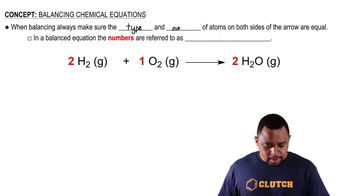
Balancing Chemical Equations
Balancing chemical equations involves ensuring that the number of atoms for each element is the same on both sides of the equation. This is based on the law of conservation of mass, which states that matter cannot be created or destroyed in a chemical reaction. To balance an equation, coefficients are adjusted in front of the chemical formulas to achieve equal atom counts.
Recommended video:
Guided course
Balancing Chemical Equations
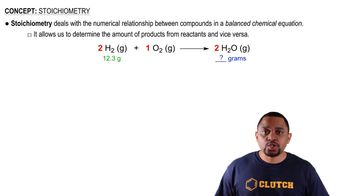
Stoichiometry
Stoichiometry is the quantitative relationship between reactants and products in a chemical reaction. It allows chemists to predict the amounts of substances consumed and produced in a reaction based on balanced equations. Understanding stoichiometry is essential for calculating yields, determining limiting reactants, and performing conversions between moles and grams.
Recommended video:
Guided course
Stoichiometry Concept
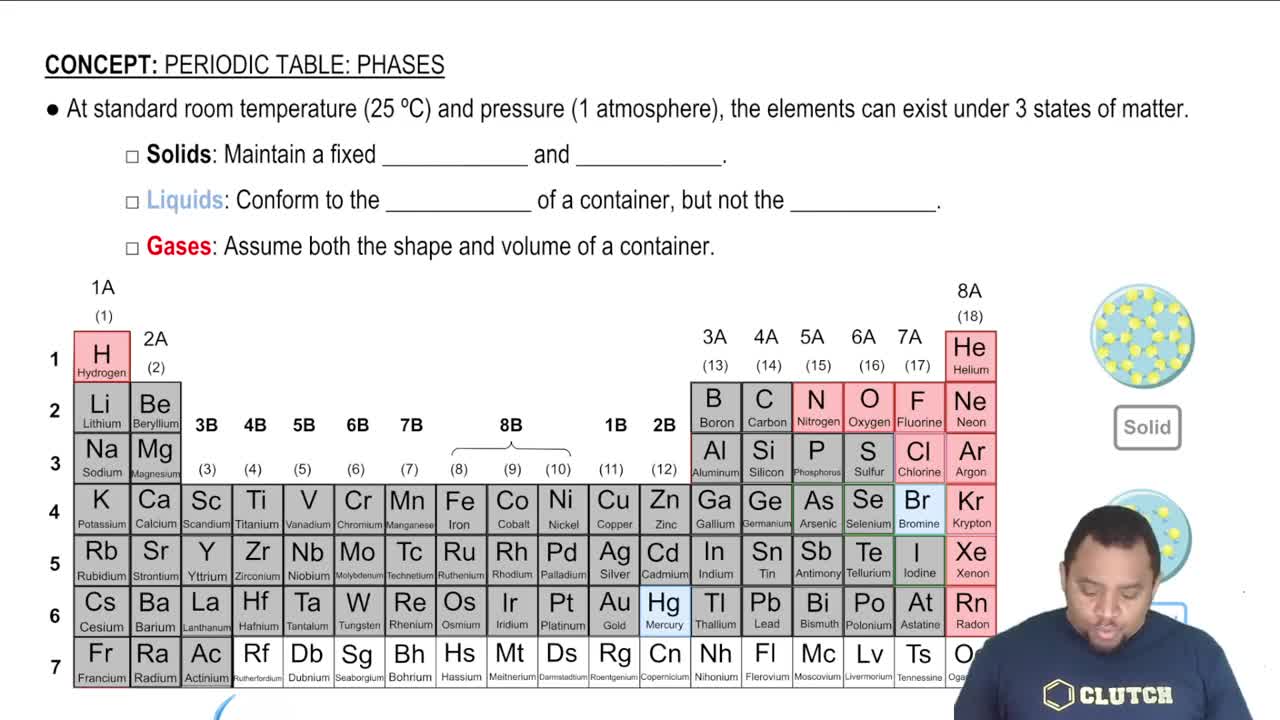
States of Matter
The states of matter refer to the distinct forms that different phases of matter take on, primarily solid, liquid, and gas. In chemical equations, the physical state of each substance is indicated by symbols: (s) for solid, (l) for liquid, and (g) for gas. Recognizing these states is important for understanding the behavior of substances during reactions and for accurately representing the reaction conditions.
Recommended video:
Guided course
Element States of Matter
Related Practice
Textbook Question
Textbook Question
Write 'true' or 'false' for each statement. (a) We balance chemical equations as we do because energy must be conserved.
Textbook Question
Balance the following equations: d. AlCl3(π )+Ca3N2(π )βΆAlN(π )+CaCl2(π )
Textbook Question
Balance the following equations: c. NH4NO3(π )βΆN2(π)+O2(π)+H2O(π)
Textbook Question
Write 'true' or 'false' for each statement. (b) If the reaction 2 O3(g) β 3 O2(g) goes to completion and all O3 is converted to O2, then the mass of O3 at the beginning of the reaction must be the same as the mass of O2 at the end of the reaction.
1
views
Textbook Question
Balance the following equations: b. TiCl4(π)+H2O(π)βΆTiO2(π )+HCl(ππ)
