A laboratory rat is exposed to an alpha-radiation source whose activity is 14.3 mCi. (a) What is the activity of the radiation in disintegrations per second? In becquerels?
Ch.21 - Nuclear Chemistry

Brown15th EditionChemistry: The Central ScienceISBN: 9780137542970Not the one you use?Change textbook
Chapter 21, Problem 71a
The table provided gives the number of protons (p) and neutrons (n) for four isotopes, identified only as (i)–(iv). a. Write the symbol for each of the isotopes.
Verified step by step guidance1
insert step 1> Identify the number of protons (p) for each isotope, as this determines the element. Use the periodic table to find the element symbol corresponding to each number of protons.
insert step 2> For each isotope, use the formula for the mass number (A), which is the sum of protons and neutrons: A = p + n.
insert step 3> Write the isotope symbol in the format: ^{A}_{Z}X, where A is the mass number, Z is the atomic number (number of protons), and X is the element symbol.
insert step 4> Repeat the process for each isotope (i)–(iv) using their respective numbers of protons and neutrons.
insert step 5> Ensure that each isotope symbol is correctly formatted and corresponds to the correct element and mass number.

Verified video answer for a similar problem:
This video solution was recommended by our tutors as helpful for the problem above.
Video duration:
2mWas this helpful?
Key Concepts
Here are the essential concepts you must grasp in order to answer the question correctly.
Isotopes
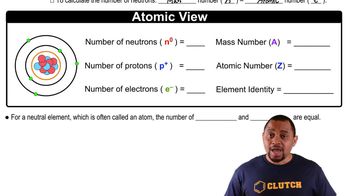
Isotopes are variants of a particular chemical element that have the same number of protons but different numbers of neutrons. This difference in neutron count results in varying atomic masses for the isotopes. For example, carbon-12 and carbon-14 are both isotopes of carbon, with 6 protons but 6 and 8 neutrons, respectively.
Recommended video:
Guided course
Isotopes
Nuclear Notation
Nuclear notation is a way of representing isotopes using the element's symbol, along with the mass number (the sum of protons and neutrons) as a superscript and the atomic number (the number of protons) as a subscript. For instance, the nuclear notation for carbon-14 is written as ¹⁴₆C, where 14 is the mass number and 6 is the atomic number.
Recommended video:
Guided course
Standard Notation to Scientific Notation
Atomic Structure
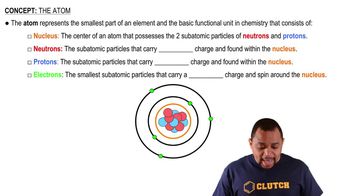
The atomic structure refers to the arrangement of protons, neutrons, and electrons within an atom. Protons and neutrons reside in the nucleus, while electrons orbit around the nucleus. Understanding atomic structure is essential for identifying isotopes, as it helps in determining the number of protons and neutrons that define each isotope's unique characteristics.
Recommended video:
Guided course
Atom Structure
Related Practice
Textbook Question
2
views
Textbook Question
Which are classified as ionizing radiation: X rays, alpha particles, microwaves from a cell phone, and gamma rays?
Textbook Question
Radon-222 decays to a stable nucleus by a series of three alpha emissions and two beta emissions. What is the stable nucleus that is formed?
Textbook Question
A laboratory rat is exposed to an alpha-radiation source whose activity is 14.3 mCi. (b) The rat has a mass of 385 g and is exposed to the radiation for 14.0 s, absorbing 35% of the emitted alpha particles, each having an energy of 9.12 * 10-13 J. Calculate the absorbed dose in millirads and grays.
Textbook Question
Chlorine has two stable nuclides, 35Cl and 37Cl. In contrast, 36Cl is a radioactive nuclide that decays by beta emission. (a) What is the product of decay of 36Cl?