
Textbook Question
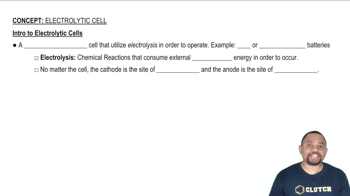
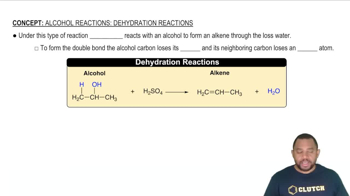
(d) Why are active metals such as Al obtained by electrolysis using molten salts rather than aqueous solutions?

 Verified step by step guidance
 01:21
01:21
 01:30
01:30 02:11
02:11(d) Why are active metals such as Al obtained by electrolysis using molten salts rather than aqueous solutions?
(d) Why is sodium metal not obtained when an aqueous solution of NaCl undergoes electrolysis?
Iron corrodes to produce rust, Fe2O3, but other corrosion products that can form are Fe(O)(OH), iron oxyhydroxide, and magnetite, Fe3O4. (a) What is the oxidation number of Fe in iron oxyhydroxide, assuming oxygen's oxidation number is -2? (b) The oxidation number for Fe in magnetite was controversial for a long time. If we assume that oxygen’s oxidation number is - 2, and Fe has a unique oxidation number, what is the oxidation number for Fe in magnetite? (O)(OH), iron oxyhydroxide, and magnetite, Fe3O4. (c) It turns out that there are two different kinds of Fe in magnetite that have different oxidation numbers. Suggest what these oxidation numbers are and what their relative stoichiometry must be, assuming oxygen’s oxidation number is -2.
(a) A Cr3+(aq) solution is electrolyzed, using a current of 7.60 A. What mass of Cr(s) is plated out after 2.00 days?
Copper corrodes to cuprous oxide, Cu2O, or cupric oxide, CuO, depending on environmental conditions. (a) What is the oxidation state of copper in cuprous oxide?