
Textbook Question
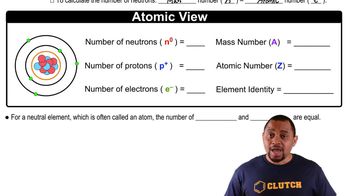
The first atoms of seaborgium (Sg) were identified in 1974. The longest-lived isotope of Sg has a mass number of 266. (a) How many protons, electrons, and neutrons are in an 266Sg atom?
3
views

 Verified step by step guidance
 04:36
04:36
 02:53
02:53 5:42
5:42The first atoms of seaborgium (Sg) were identified in 1974. The longest-lived isotope of Sg has a mass number of 266. (a) How many protons, electrons, and neutrons are in an 266Sg atom?
There are two different isotopes of bromine atoms. Under normal conditions, elemental bromine consists of molecules, and the mass of a molecule is the sum of the masses of the two atoms in the molecule. The mass spectrum of consists of three peaks: m/zRelative Peak Intensity157.836 0.2569 159.834 0.4999 161.832 0.2431
b. What is the mass of each isotope?
There are two different isotopes of bromine atoms. Under normal conditions, elemental bromine consists of molecules, and the mass of a molecule is the sum of the masses of the two atoms in the molecule. The mass spectrum of consists of three peaks: m/zRelative Peak Intensity157.836 0.2569 159.834 0.4999 161.832 0.2431
d. Determine the average atomic mass of a bromine atom.
From the following list of elements—Ar, H, Ga, Al, Ca, Br, Ge, K, O—pick the one that best fits each description. Use each element only once: (a) an alkali metal, (b) an alkaline earth metal, (c) a noble gas, (d) a halogen, (e) a metalloid, (f) a nonmetal listed in group 1A, (g) a metal that forms a 3+ ion, (h) a nonmetal that forms a 2- ion, (i) an element that resembles aluminum.
There are two different isotopes of bromine atoms. Under normal conditions, elemental bromine consists of molecules, and the mass of a molecule is the sum of the masses of the two atoms in the molecule. The mass spectrum of consists of three peaks: m/zRelative Peak Intensity157.836 0.2569 159.834 0.4999 161.832 0.2431
c. Determine the average molecular mass of a molecule.
It is common in mass spectrometry to assume that the mass of a cation is the same as that of its parent atom. (b) What percentage of the mass of an 1H atom does the electron represent?