
Indicate whether each statement is true or false. (a) A reaction that is spontaneous in one direction will be nonspontaneous in the reverse direction under the same reaction conditions. (b) All spontaneous processes are fast. (c) Most spontaneous processes are reversible. (d) An isothermal process is one in which the system loses no heat. (e) The maximum amount of work can be accomplished by an irreversible process rather than a reversible one.
Ch.19 - Chemical Thermodynamics

Brown15th EditionChemistry: The Central ScienceISBN: 9780137542970Not the one you use?Change textbook
Chapter 19, Problem 12
Which of the following processes are spontaneous?
a. the melting of ice cubes at −10 °C and 1 atm pressure
b. separating a mixture of N2 and O2 into two separate samples, one that is pure N2 and one that is pure O2
c. alignment of iron filings in a magnetic field
d. the reaction of hydrogen gas with oxygen gas to form water vapor at room temperature
e. the dissolution of HCl(g) in water to form concentrated hydrochloric acid
Verified step by step guidance1
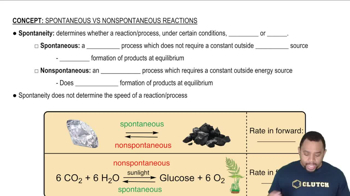
Step 1: Understand the concept of spontaneity in chemical processes. A spontaneous process is one that occurs naturally under given conditions without needing external energy input. It is often associated with an increase in entropy or a decrease in free energy.
Step 2: Analyze option (a): The melting of ice cubes at -10 °C and 1 atm pressure. Consider the phase change and the temperature. Ice melts spontaneously at temperatures above 0 °C, so at -10 °C, this process is not spontaneous.
Step 3: Analyze option (b): Separating a mixture of N2 and O2 into pure samples. This process decreases entropy because it involves creating order from disorder, which is not spontaneous without external work.
Step 4: Analyze option (c): Alignment of iron filings in a magnetic field. This process is spontaneous because the magnetic field provides the necessary energy to align the filings, and it occurs naturally when the filings are exposed to the field.
Step 5: Analyze option (d) and (e): The reaction of hydrogen gas with oxygen gas to form water vapor is spontaneous at room temperature due to the release of energy (exothermic reaction). The dissolution of HCl(g) in water is also spontaneous as it involves the release of energy and an increase in entropy.

Verified video answer for a similar problem:
This video solution was recommended by our tutors as helpful for the problem above.
Video duration:
1mWas this helpful?
Key Concepts
Here are the essential concepts you must grasp in order to answer the question correctly.
Spontaneity in Chemical Processes
A spontaneous process is one that occurs without the need for external energy input. It is driven by the increase in the system's entropy or the decrease in its Gibbs free energy. Understanding spontaneity helps predict whether a reaction or physical change will occur under given conditions.
Recommended video:
Guided course
Spontaneity of Processes
Entropy and Temperature
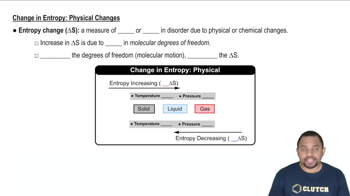
Entropy is a measure of the disorder or randomness in a system. As temperature increases, the entropy of a system typically increases, which can influence the spontaneity of processes. For example, the melting of ice at higher temperatures is spontaneous due to increased molecular motion and disorder.
Recommended video:
Guided course
Entropy and Physical Changes
Gibbs Free Energy
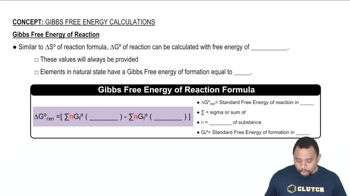
Gibbs free energy (G) combines enthalpy and entropy to determine the spontaneity of a process at constant temperature and pressure. A negative change in Gibbs free energy (ΔG < 0) indicates a spontaneous process, while a positive change (ΔG > 0) suggests non-spontaneity. This concept is crucial for evaluating chemical reactions and physical changes.
Recommended video:
Guided course
Gibbs Free Energy of Reactions
Related Practice
Textbook Question
Textbook Question
(d) Does the amount of work that a system can do on its surroundings depend on the path of the process?
2
views
Textbook Question
Which of the following processes are spontaneous and which are nonspontaneous: (d) lightning
2
views
Textbook Question
Which of the following processes are spontaneous and which are nonspontaneous: (e) formation of CH4 and O2 molecules from CO2 and H2O at room temperature and 1 atm of pressure?
Textbook Question
Consider the vaporization of liquid water to steam at a pressure of 1 atm. (a) Is this process endothermic or exothermic?
1
views
Textbook Question
Which of the following processes are spontaneous and which are nonspontaneous: (a) the ripening of a banana
