Consider a reaction A2(π) + B2(π) β 2 AB(π), atoms of A shown in red in the diagram and atoms of B shown in blue. (a) If πΎπ = 1, which box represents the system at equilibrium?
Ch.19 - Chemical Thermodynamics

Brown15th EditionChemistry: The Central ScienceISBN: 9780137542970Not the one you use?Change textbook
Chapter 19, Problem 6b
Isomers are molecules that have the same chemical formula but different arrangements of atoms, as shown here for two isomers of pentane, C5H12.
(b) Which isomer do you expect to have the higher standard molar entropy? Explain.
Verified step by step guidance1
Identify the structural differences between the two isomers of pentane, C5H12. Note how the atoms are arranged differently in each isomer.
Understand the concept of standard molar entropy, which is a measure of the randomness or disorder in a system. More complex molecular structures with greater freedom of movement typically have higher entropy.
Compare the complexity and branching of the isomers. Isomers with more branching generally have less freedom of movement because the branches restrict the rotation of the molecule's bonds.
Determine which isomer has less branching. This isomer will likely have higher standard molar entropy because its molecular structure allows for greater freedom of movement and more possible microstates.
Conclude that the isomer with the simpler, less branched structure typically has a higher standard molar entropy due to its increased molecular freedom compared to a more branched isomer.

Verified video answer for a similar problem:
This video solution was recommended by our tutors as helpful for the problem above.
Video duration:
2mWas this helpful?
Key Concepts
Here are the essential concepts you must grasp in order to answer the question correctly.
Isomerism
Isomerism refers to the phenomenon where two or more compounds have the same molecular formula but differ in the arrangement of atoms. This can lead to distinct physical and chemical properties, as seen in structural isomers like the different forms of pentane. Understanding isomerism is crucial for predicting how these compounds will behave in various chemical contexts.
Recommended video:
Guided course
Isomerism in Coordination Complexes Example
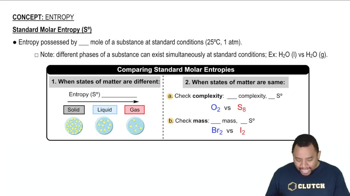
Standard Molar Entropy
Standard molar entropy is a measure of the amount of disorder or randomness in a system at standard conditions (1 bar and 25Β°C). It is an important thermodynamic property that reflects the number of accessible microstates for a given substance. Generally, more complex molecules with greater degrees of freedom and larger surface areas have higher entropies.
Recommended video:
Guided course
Standard Molar Entropy
Effect of Molecular Structure on Entropy
The molecular structure significantly influences the entropy of isomers. For instance, branched isomers tend to have lower entropy than their straight-chain counterparts due to reduced molecular motion and fewer conformations. In the case of pentane isomers, the straight-chain form typically exhibits higher entropy because it has more possible arrangements and interactions compared to its branched isomer.
Recommended video:
Guided course
Entropy and Physical Changes
Related Practice
Textbook Question
2
views
Textbook Question
The accompanying diagram shows how entropy varies with temperature for a substance that is a gas at the highest temperature shown. (c) If this substance is a perfect crystal at T = 0 K, what is the value of S at this temperature?
2
views
Textbook Question
Predict the signs of ΞH and ΞS for this reaction. Explain your choice.
Textbook Question
Consider a reaction A2(π) + B2(π) β 2 AB(π), atoms of A shown in red in the diagram and atoms of B shown in blue. (b) If πΎπ = 1, which box represents the system at π < πΎπ?
1
views
Textbook Question
Isomers are molecules that have the same chemical formula but different arrangements of atoms, as shown here for two isomers of pentane, C5H12.
(a) Do you expect a significant difference in the enthalpy of combustion of the two isomers? Explain.