
Textbook Question
Consider the reaction 3 CH4(g) → C3H8(g) + 2 H2(g). (a) Using data from Appendix C, calculate ΔG° at 298 K.

 Verified step by step guidance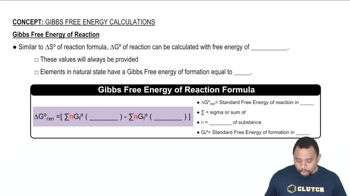
 01:51
01:51
 07:32
07:32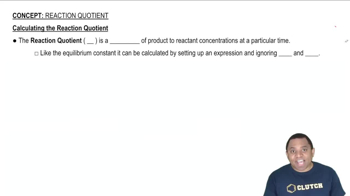 00:49
00:49Consider the reaction 3 CH4(g) → C3H8(g) + 2 H2(g). (a) Using data from Appendix C, calculate ΔG° at 298 K.
The fuel in high-efficiency natural-gas vehicles consists primarily of methane (CH4). (a) How much heat is produced in burning 1 mol of CH4(g) under standard conditions if reactants and products are brought to 298 K and H2O(l) is formed?
Consider the reaction 2 NO2(g) → N2O4(g). (a) Using data from Appendix C, calculate ΔG° at 298 K. (b) Calculate ΔG at 298 K if the partial pressures of NO2 and N2O4 are 0.40 atm and 1.60 atm, respectively.
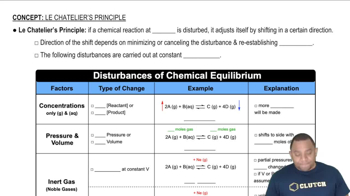
Consider the reaction 3 CH4(g) → C3H8(g) + 2 H2(g). (b) Calculate ΔG at 298 K if the reaction mixture consists of 40.0 atm of CH4, 0.0100 atm of C3H8(g), and 0.0180 atm of H2.
The fuel in high-efficiency natural-gas vehicles consists primarily of methane (CH4). (b) What is the maximum amount of useful work that can be accomplished under standard conditions by this system?