
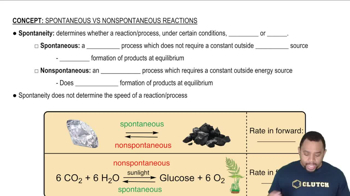
For each of the following processes, indicate whether the signs of ΔS and ΔH are expected to be positive, negative, or about zero. (a) A solid sublimes. (b) The temperature of a sample of Co(s) is lowered from 60 °C to 25 °C. (c) Ethyl alcohol evaporates from a beaker. (d) A diatomic molecule dissociates into atoms. (e) A piece of charcoal is combusted to form CO2(g) and H2O(g).

(d) For a reversible isothermal process, write an expression for ΔE in terms of q and w and an expression for ΔS in terms of q and T.
Verified step by step guidance
Verified video answer for a similar problem:
Key Concepts
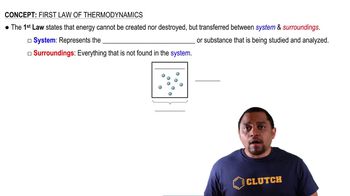
First Law of Thermodynamics
Isothermal Process
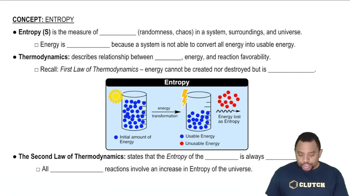
Entropy (ΔS)
The Kb for methylamine (CH3NH2) at 25 °C is given in Appendix D. (d) What is the value of ΔG when [H+] = 6.7 × 10⁻⁹ M, [CH3NH3+] = 2.4 × 10⁻³ M, and [CH3NH2] = 0.098 M?
The crystalline hydrate Cd(NO3)2⋅4 H2O(s) loses water when placed in a large, closed, dry vessel at room temperature: Cd(NO3)2⋅4 H2O(s) → Cd(NO3)2(s) + 4 H2O(g) This process is spontaneous and ΔH° is positive at room temperature.
(b) If the hydrated compound is placed in a large, closed vessel that already contains a large amount of water vapor, does ΔS° change for this reaction at room temperature?
(a) Which of the thermodynamic quantities T, E, q, w, and S are state functions? (b) Which depend on the path taken from one state to another?
The Kb for methylamine (CH3NH2) at 25 °C is given in Appendix D. (a) Write the chemical equation for the equilibrium that corresponds to Kb.
The crystalline hydrate Cd(NO3)2⋅4 H2O(s) loses water when placed in a large, closed, dry vessel at room temperature: Cd(NO3)2⋅4 H2O(s) → Cd(NO3)2(s) + 4 H2O(g) This process is spontaneous and ΔH° is positive at room temperature.
(a) What is the sign of ΔS° at room temperature?
