
Rainwater is acidic because CO21g2 dissolves in the water, creating carbonic acid, H2CO3. If the rainwater is too acidic, it will react with limestone and seashells (which are principally made of calcium carbonate, CaCO3). Calculate the concentrations of carbonic acid, bicarbonate ion 1HCO3-2 and carbonate ion 1CO32 - 2 that are in a raindrop that has a pH of 5.60, assuming that the sum of all three species in the raindrop is 1.0 * 10-5 M.
Ch.17 - Additional Aspects of Aqueous Equilibria

Brown15th EditionChemistry: The Central ScienceISBN: 9780137542970Not the one you use?Change textbook
Chapter 17, Problem 83
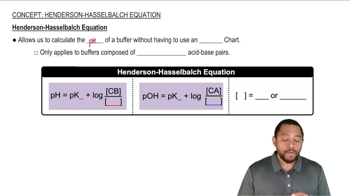
Which of these equations relates the pOH of a buffer to the p𝐾𝑏 of its weak base, analogous to the Henderson–Hasselbalch equation for weak acids?
a. p𝐾𝑏=pOH+p𝐾𝑏=pOH+log[acid]/[base]
b. p𝐾𝑏=pOH−log[acid]/[base]
c. p𝐾𝑏=pOH−log[base]/[acid]
d. p𝐾𝑏=pOH+log[base]/[[acid]
Verified step by step guidance1
Identify the Henderson-Hasselbalch equation for weak acids: \( \text{pH} = \text{pK}_a + \log \left( \frac{[\text{base}]}{[\text{acid}]} \right) \).
Recognize that the analogous equation for bases involves pOH and pK_b.
The equation should relate pOH to pK_b and the ratio of concentrations of the base and its conjugate acid.
The correct form should be \( \text{pOH} = \text{pK}_b + \log \left( \frac{[\text{acid}]}{[\text{base}]} \right) \).
Match this form to the given options to find the correct answer.

Verified video answer for a similar problem:
This video solution was recommended by our tutors as helpful for the problem above.
Video duration:
5mWas this helpful?
Key Concepts
Here are the essential concepts you must grasp in order to answer the question correctly.
Henderson-Hasselbalch Equation
The Henderson-Hasselbalch equation is a formula used to calculate the pH of a buffer solution. It relates the pH to the pKa of the weak acid and the ratio of the concentrations of the conjugate base and the weak acid. This equation can be adapted for bases, allowing for the calculation of pOH in relation to pKb and the concentrations of the acid and base components.
Recommended video:
Guided course
Henderson-Hasselbalch Equation
pOH and pKb Relationship
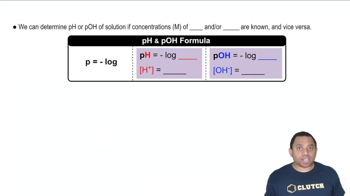
pOH is a measure of the hydroxide ion concentration in a solution, while pKb is the base dissociation constant that indicates the strength of a weak base. The relationship between pOH and pKb is crucial for understanding buffer systems involving weak bases. By manipulating these values, one can derive equations that express the pOH in terms of pKb and the concentrations of the acid and base.
Recommended video:
Guided course
pH and pOH Calculations
Buffer Solutions
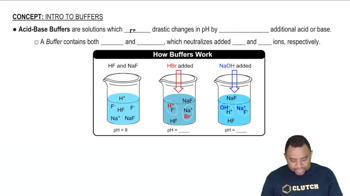
Buffer solutions are mixtures that resist changes in pH when small amounts of acid or base are added. They typically consist of a weak acid and its conjugate base or a weak base and its conjugate acid. Understanding how buffers work is essential for applying the Henderson-Hasselbalch equation and its variations, as they help maintain pH stability in biological and chemical systems.
Recommended video:
Guided course
Buffer Solutions
Related Practice
Textbook Question
Textbook Question
Suggest how the cations in each of the following solution mixtures can be separated: (c) Pb2 + and Al3 +.
1
views
Textbook Question
(b) What is the most significant difference between the sulfides precipitated in group 2 and those precipitated in group 3?
Textbook Question
The acid–base indicator bromcresol green is a weak acid. The yellow acid and blue base forms of the indicator are present in equal concentrations in a solution when the pH is 4.68. What is the pKa for bromcresol green?
Textbook Question
In the course of various qualitative analysis procedures, the following mixtures are encountered: (c) Mg2+ and K+ (d) Ag+ and Mn2+. Suggest how each mixture might be separated.
1
views
